

Articles
Filters & sorting
Articles in the database: 2
Localization for Poland and Continia Document Capture: bridging KSeF compliance with purchase invoice automation
In the Polish Business Central landscape, compliance with KSeF is only part of the story. The real challenge for many customers begins after the invoice is received: how to process it efficiently within existing purchase invoice workflows.
For organizations using both Localization for Poland and Continia Document Capture, this has typically meant dealing with a gap between compliance and operational automation. While Localization for Poland ensures correct retrieval and handling of KSeF invoices, Continia provides advanced tools for processing and posting purchase invoices. Connecting these two areas in a clean, repeatable and efficient way has not been straightforward before.
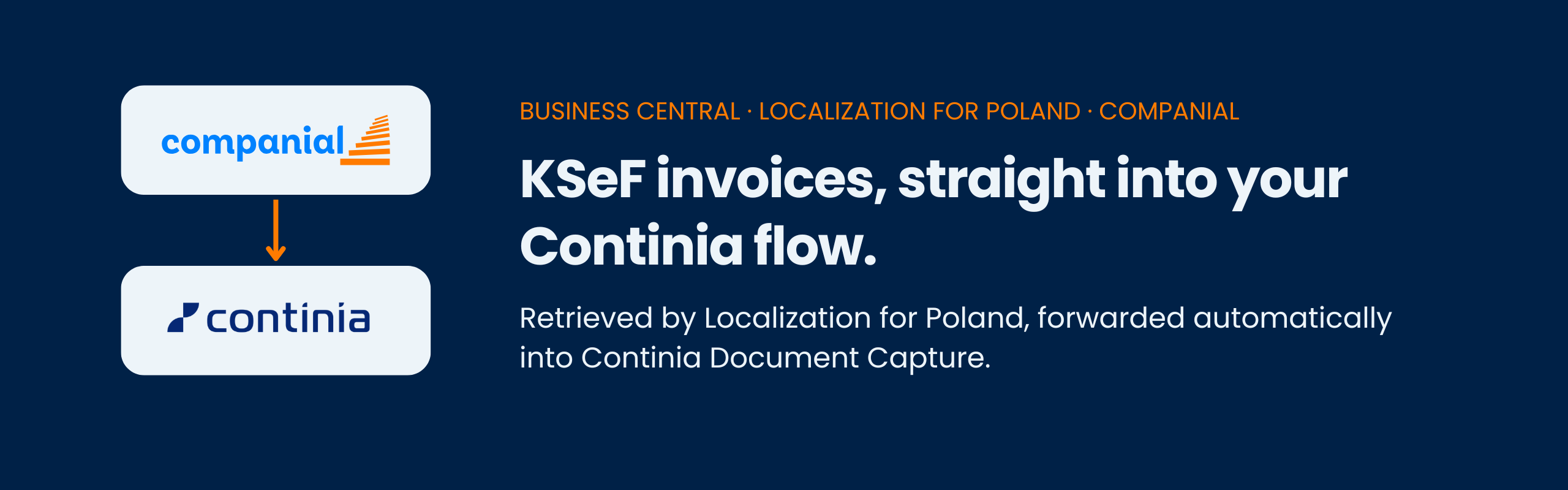
Companial addresses this with a dedicated integration application that links Localization for Poland with Continia Document Capture, enabling automatic transfer of incoming KSeF invoices via the Continia Delivery Network.
This creates a practical bridge between compliance and automation – without introducing custom integrations that are difficult to maintain over time.
From compliance to process continuity
KSeF defines how invoices are exchanged and structured, but it does not define how organizations handle them internally. Each customer has their own processes, approval flows and operational requirements.
Localization for Poland covers the compliance layer – including KSeF communication and data structures – ensuring that invoices are correctly retrieved and stored as e‑documents. However, this is only the starting point of the purchase invoice lifecycle.
The integration with Continia extends this standard flow by ensuring that once a document is processed in Localization for Poland, it can seamlessly continue into the Continia Document Capture process.
How the integration works
The integration focuses on incoming purchase invoices retrieved from KSeF and follows a structured, automated flow:
Localization for Poland retrieves purchase invoices from KSeF into Business Central.
Each document is created as an e-document with the related XML file imported from KSeF attached to it.
The XML file is then automatically forwarded to the Continia Delivery Network.
The invoice becomes available in Continia Inbound E-Documents.
Further processing – including recognition, matching and posting – is handled within Continia Document Capture, based on the relevant Continia configuration.
The transfer is triggered automatically once the integration is enabled, assuming the required setup is in place on both sides.
A standard approach instead of custom integration
A recurring challenge in KSeF-related implementations is the need to connect compliance processes with customer-specific workflows. This could lead to custom integrations that increase complexity and make future updates harder to manage.
This application follows a different approach.
It does not replace the standard KSeF process delivered by Localization for Poland, nor does it modify Continia functionality. Instead, it acts as a dedicated, standard bridge between the two, allowing both solutions to remain aligned with their respective update cycles.
If the integration is disabled, the standard KSeF flow in Localization for Poland continues unchanged.
What this means in practice
For customers, the key benefit is process continuity:
KSeF invoices are automatically transferred into the Continia processing flow,
no separate handover or manual intervention is required once the integration and required Continia setup are in place,
existing Continia-based automation can continue to be used,
the overall purchase invoice process remains consistent and scalable.
For partners, this simplifies solution design. Instead of building and maintaining custom “connectors”, they can rely on a predefined integration scenario that aligns with standard Business Central architecture.
Observability and control
Automation does not remove the need for visibility.
The integration provides a dedicated setup and logging mechanism, allowing users to:
enable or disable the transfer process,
review document transfer history,
monitor success and failure statuses,
manage retention of upload logs.
This ensures that the transfer process is not only automated, but also traceable and easier to support.
Where this fits in customer scenarios
The integration is particularly relevant in environments where:
KSeF is already used or being implemented in Business Central,
Continia Document Capture is part of the purchase invoice process,
customers want to avoid process-specific integrations (processes may change in time),
long-term maintainability is a priority.
In such cases, the application provides a clean transition from regulatory compliance to operational processing.
Closing the gap between systems
As KSeF adoption became mandatory, more organizations are moving toward fully digital invoice processes. At the same time, they expect these processes to remain efficient and integrated.
By connecting Localization for Poland with Continia Document Capture, this application addresses a specific but common challenge: how to move KSeF invoices into an existing automation workflow without adding unnecessary complexity.
It reflects a broader shift in how Localization for Poland supports customers – from isolated compliance handling toward integrated, end-to-end process design.
Availability
The application is available on Microsoft Marketplace as Localization for Poland – Continia Integration.
For organizations already using both Localization for Poland and Continia Document Capture, it provides a ready and maintainable way to connect KSeF invoice retrieval with purchase invoice automation, while keeping each solution responsible for its own part of the process.

RadosławDudziak
KSeF and Localization for Poland: where compliance ends and partner extensibility begins
Compliance is the floor. Partner work picks up from there.
One compliance standard, no two customer processes
Every partner working with Microsoft Dynamics 365 Business Central in Poland runs into the same tension: strict regulatory compliance on one side, highly individual customer processes on the other. Localization for Poland covers the core compliance areas, including KSeF, VAT-EU and SAFT/JPK, in line with current Polish regulatory requirements and official reporting structures. But regulations define what has to be reported, not how a company runs the process around it, and no two customers run that process the same way. One runs split payments across two currencies. Another handles purchase corrections in ways that do not fit a universal default approach. That gap between compliance and operational reality is where most implementation friction lives.
For a long time, closing that gap meant choosing between two bad options: bend the customer’s process to fit the standard, or fork the localization and lose the ability to update cleanly. Neither holds up over a few release cycles. Localization for Poland provides the standard compliance processes required for Polish regulations, while also exposing extension points for customer-specific scenarios that go beyond the standard scope. Integration events are how that works in practice: customer-specific logic can be implemented through extensions, helping partners avoid modifications to the standard localization and making future updates easier to manage.
Extending correction handling for purchase credit memos
Take a concrete case: purchase credit memos that carry before-and-after correction lines, common in line-level price or quantity corrections. KSeF provides structured data for these documents, but it does not define a single required way to reconstruct them in Business Central. For complex purchase correction scenarios, including documents with before-and-after line structures, the standard localization prioritizes safe and consistent import behavior. Where customer-specific handling is required, partners can use available extension points in purchase document creation and data mapping logic instead of modifying the standard solution.
Reusing the invoice preview instead of rebuilding it
A smaller example, but one that comes up constantly in multi-system environments: invoice visualization. Localization for Poland already provides invoice preview capabilities inside Business Central, including preview based on KSeF data and XSLT-based rendering. In customer-specific projects, partners can build on these existing preview capabilities instead of recreating the entire presentation layer from scratch. That helps keep document presentation consistent across systems without duplicating functionality that already exists.
VAT-EU and VIES: where to check before scoping
Both examples point to the same shift. Localization for Poland handles KSeF schemas and communication with the official system, so partners do not have to rebuild that layer themselves, while partner extensions are meant to complement the standard scope where customer-specific process logic is needed. The same logic applies to VAT-EU and VIES qualification, where partners may need to adjust how transactions are classified or apply customer-specific rules. Depending on the scenario, partners should verify early whether the required VAT-EU / VIES functionality and related extension options are available in the relevant Localization for Poland scope, as this can affect solution design and licensing.
Where this leaves partners
None of this requires forking anything or maintaining a parallel version of the localization. It requires knowing which extension points exist and where to use them. For partners building out their Polish practice, that is increasingly the more useful question: not whether the standard covers every scenario, but where the right hook is to extend it.
Curious which extension points fit a specific customer scenario? Worth a conversation.
RadosławDudziak

You've seen 2 of 2 articles
That's all