

MES
Articles in the database: 5
How to Automate Machine Data Collection?
Machine data collection is the foundation of reliable OEE (Overall Equipment Effectiveness) analysis. Without it, it is hard to speak of proper control over factory efficiency. How can this be properly automated so that analytics are no longer based on guessing and manual reporting?
Automated data acquisition drastically changes daily work on the shop floor, significantly streamlining it. The system is the first to notice a failure. Instead of forcing an employee to manually record the start and end times of a downtime, the software automatically registers every stop, even the shortest ones.
The very nature of the operator’s work also changes. With digitalization, their task is reduced solely to categorizing the event that occurred. It is worth noting that in modern implementations, the downtime reason code itself can be delivered to the system automatically, directly from the machine (e.g., via communication protocols such as OPC). In such cases, the employee simply verifies the correctness of the automatically assigned code on a dedicated touchscreen. They can also leave their own comment or note, which supplements the raw machine data with unique context.
What Is the Significance of Machine Data Collection For Analytics?
Depending on the machine type, systems can collect a single key signal or a whole range of them. The Operator Datalogger module allows for the collection of various production and environmental metrics.
Even seemingly simple information can provide key business insights:
Machine operating status – for example, this can be determined based on measuring the energy consumption of a machine tool spindle.
Number of cycles (takt times) – counted, for instance, based on every pedal press by a press brake operator.
Automatic error and downtime codes – if these are generated by the machine, the system helps identify the cause of the production stop. A specific error code immediately appears on the digital screen.
Process and environmental parameters – such as current temperature, pressure, voltage, humidity, or shaft speed. These are recorded from sensors in real-time.
Thanks to built-in algorithms, these basic signals are analyzed in real-time. This allows for the precise identification of machine availability issues, such as breakdowns, unplanned downtimes, or speed drops.
Statistical Process Control – What Is It All About?
Monitoring efficiency using the OEE indicator is only half the battle. Gathering process and environmental data directly from the workstation is equally important. This is the purpose of Statistical Process Control (SPC), a method of monitoring a process using statistical data aimed at verifying whether the process is behaving stably and predictably, or if unusual disturbances are occurring.
Implementing the SPC module in an MES (Manufacturing Execution System) allows for continuous tracking of variability—that is, differences resulting from material properties, micro-fluctuations in temperature, standard machine and operator work, etc. Crucially, the software measures process stability and allows for the early identification of a problem before parameters exceed nominal critical values and control limits. The system analyzes deviations based on advanced statistical rules, e.g., the three-sigma rule.
This solution makes it possible to catch deviations and problems before they negatively impact the final product, significantly reducing waste. Additionally, the system sends proactive alerts. When the value of a monitored machine parameter exceeds a set level, the system automatically generates notifications via email, SMS, or as an alarm on dashboards.
However, it is worth remembering that simply implementing software for automated machine data analysis will not fully replace the SPC methodology. In reality, Statistical Process Control is a much broader engineering approach, encompassing, among other things, conducting a reliable measurement system analysis.
An MES system like the Operator Platform provides an incredibly powerful tool that helps quickly catch process instability. However, the foundation of success remains the implementation of the SPC culture and comprehensive methodology itself by the engineers at the manufacturing plant.
How to Communicate with a Machine Effectively?
The method of data acquisition strictly depends on analytical expectations. The Operator Platform supports a wide spectrum of communication protocols. The most effective and recommended solution is direct communication via OPC / OPC UA or a modern IoT protocol, such as MQTT. These ensure seamless, real-time data transmission.
Alternative solutions also exist. The system can be integrated with machines through direct database connections, REST API services, or even file interfaces (e.g., CSV, XML). However, one must keep in mind the technological limitations of each method. If the business goal is to capture micro-stoppages lasting just a few seconds, relying on importing CSV files generated by the machine every minute will be technically insufficient. In such cases, real-time communication is essential.
An Older Machine Park Is Not a Dead End
Many manufacturers fear that the lack of modern interfaces in older equipment makes digitalization impossible. Nothing could be further from the truth. When direct access to data from a PLC controller is difficult, there are several proven integration paths:
Software modification – interfering with the controllers’ source code (usually possible for machines to which the plant has full access and rights).
Cooperation with the supplier – establishing direct contact with the machine manufacturer to make the appropriate registers accessible.
Retrofitting with sensors (“Sensorization”) – the most universal solution. It involves equipping older equipment with independent, modern sensors connected to an external data analyzer or I/O module. These elements translate the machine’s physical operation into digital signals understandable by the MES system.
Full Partnership Support
The approach to the digital transformation of a production hall must be flexible. The Operator Platform enables the implementation of all the hardware integration variants mentioned above. Regardless of the machine park’s age and the communication protocols used, our software successfully transforms raw machine signals into reliable indicators, providing management with the knowledge necessary to make accurate business decisions.

JakubJaszczur
Case Study: MES Implementation Like a Piece of Cake
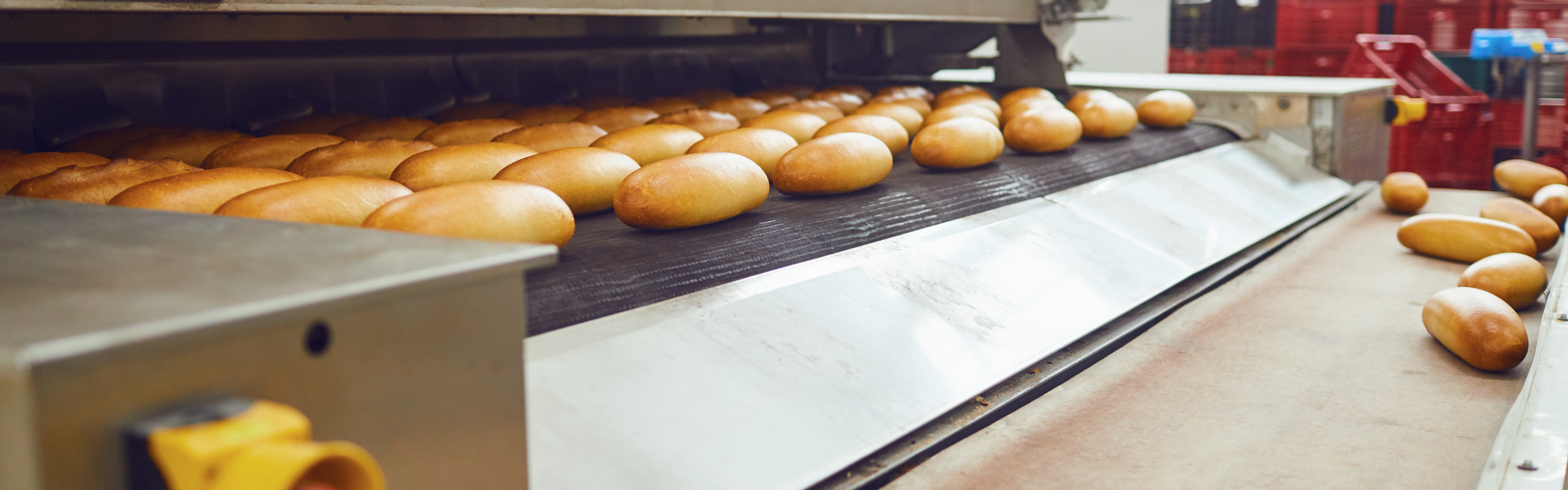
Efficient food production – especially bakery production – is a race against time. Short shelf lives and rigorous quality standards do not forgive mistakes. When it seems that the machinery park has already reached the upper limit of its capabilities, and the management begins to consider investing in new lines, it is worth asking one question: are we definitely using our full potential? The history of Lantmännen Schulstad shows that this is not necessarily the case. True production capacities often hide in micro-stoppages.
Schulstad is one of the key brands (and companies) belonging to Lantmännen Unibake. The brand ultimately joined the group in 2006, becoming an important operational element of this international powerhouse. It runs its branches not only in Scandinavian countries (Denmark, Sweden, Norway, Finland) but also in other parts of Europe.
For the bakery plants of the Lantmännen group, machines are the heart of the entire production. Five independent lines operate non-stop – 24 hours a day, 7 days a week. Each of them is characterized by different changeover times, speeds, and business goals. Operators are fully dependent on the failure-free functioning of the equipment, and every breakdown is a risk of unplanned overtime and material losses.
The company had a clear goal: to significantly increase efficiency. To achieve this, the management had to better understand how the machines actually work. A tool was needed to bring to light what was often missed on paper – micro-stoppages. The Operator Platform with a module measuring the OEE indicator helped with this.
How to tame micro-stoppages?
Traditional reports rarely record small, several-dozen-second-long stoppages. Employees simply do not have the time to write them down. However, on the scale of a week, month, or year, these small breaks begin to create a bottleneck.
The implementation of the Operator OEE module digitized this process and reversed the reporting logic. Crucially, the system does not wait for an employee to report a failure. Communicating directly with the machines, the software instantly “notices” every stop, even the shortest one. The operator on the shop floor only fills in the reasons for this stoppage on a dedicated touch screen. The reporting of daily events, therefore, takes place in real time, with flawless precision down to the second, and without burdening the crew with additional paperwork. What happens next?
Information about a failure is instantly displayed on the screens in the Maintenance Department (UR), whose main task is to maximize machine uptime. The first step for the technicians is to quickly restore production. Having precise data at their disposal, the Maintenance Department no longer acts in the dark. The team uses Pareto analysis within specific timeframes to identify those stoppages that have the greatest impact on the loss of operational time.
“Work smarter, not harder”
Digital dashboards have been installed on the production halls of Lantmännen Schulstad, visually presenting live current performance compared to the assumed target. Thanks to this, employees can see in black and white whether they are realizing the plan. This instant feedback allows them to act proactively, rather than just reacting to deviations at the end of the shift.
The use of an intuitive interface has given the factory precise data on the OEE indicator broken down into every single production order. Thanks to this, managers have unprecedented insight into the profitability of specific batches of baked goods.
Unlocking hidden capacities
The most impressive aspect of the transformation at Lantmännen Schulstad is how quickly the system brought tangible business benefits. The implementation of the software was spread out over a year, but it started with a smart step – a pilot on line number 2, which is the most complicated line in the entire plant.
The success? Instantaneous. The project paid back its investment costs already at the stage of this single pilot implementation. Once the system was optimized on the most difficult section, implementation on the remaining four lines was a simple “copy-paste” process.
The bakery network managed to find and release hidden processing capacities in its current machinery park. Instead of investing tens of millions in new machines to meet growing demand, the company squeezed more out of the equipment it already owned.
However, this is not the end of the story. The implementation of the Operator Platform in the Schulstad factory was such a spectacular success that the management of Lantmännen Unibake made a key business decision. The solution became a standard. The platform was implemented in many other factories belonging to this global group.
An industrial revolution does not always have to mean building a new factory. Sometimes it is enough to simply turn on the light in the current one. Cooperation with Operator Systems has proven that full visibility of processes is the most profitable path to manufacturing excellence.
JakubJaszczur
When It’s 30°C Outside and… 1500°C in the Hall. MES in an Extreme Environment
Summer heat can take its toll, as we have recently experienced firsthand. But what about people working physically in a production hall where machines can heat up to over a thousand degrees Celsius? One of the largest iron foundries in Europe – Vald. Birn – operates in such conditions.
Vald. Birn is a Danish company with a century-old tradition; its origins date back to 1893. Currently, the enterprise employs 1,000 workers across four factories, producing up to 3,000 different assortment items in the field of metal castings. Their clients include key automotive brands such as Volvo and Mercedes.
The metal products themselves – often critical from a safety point of view – must absolutely meet rigorous quality requirements. In such a demanding and (especially during the summer) extreme environment, there is no room for errors. That is why the digitalization of production turned out to be crucial.
Replacing Binders with an IT System
For many years, production management at Vald. Birn relied on sheets of paper. Leif Jensen, the company’s Financial Director, admits that “sticky notes and kilometers of binders” piled up everywhere on the desks. This significantly slowed down the documentation process and also caused limitations in data access.
Furthermore, the company made the decision to completely overhaul its ERP system. However, it turned out that the previous program was too much of a challenge for the operators working directly on the foundry floor, who were not accustomed to handling complex IT interfaces. Therefore, they needed something more intuitive to use.
An MES System Resistant to 1500 Degrees
To solve this problem, in parallel with the implementation of the main ERP system, the company launched the Operator MES software. Currently, it acts as an agile extension of the Infor M3 business system in a harsh production environment.
Block Quote
The implementation itself was a massive logistical undertaking. Inside the foundry, among crucibles heated to 1500°C and heavy machinery, a staggering 170 terminals were successfully deployed.
The analysis department, located directly on the production hall, became the central point to which samples flow continuously via a special pneumatic tube system. In the laboratory, the composition of 20 different alloys is verified (including the content of elements such as titanium, lead, copper, and zinc). All results of these measurements immediately go to the Operator Platform, where they are automatically linked to specific customer orders.
How to Achieve a Defect Rate Below 2%
The management of Vald. Birn considers the implementation of the Operator system a “great success from day one”. The project brought results that permanently revolutionized the daily functioning of the foundry. Among the greatest benefits the company noticed were:
Paperless approach – the paper documentation system was completely eliminated. Instead, the registration of orders, processes, and quality measurements was automated.
Full Traceability – by ensuring strict quality control, the defect rate (scrap rate) was maintained at a level below 2%.
Error identification – this process was significantly simplified and accelerated, facilitating an immediate reaction to irregularities.
Audits – the company reached a completely new level of process documentation. This resulted in an official commendation from the Bureau Veritas auditors during certification.
Intuitiveness That Builds Data Discipline
Importantly, the success of the project was determined not only by the technology itself, but by its reception by the employees – including those who were not previously used to IT solutions. Vald. Birn operators received a precisely personalized interface. Only data and registration options strictly corresponding to their current tasks appear on their screens.
The system gained tremendous appreciation, and today the employees themselves actively submit requests for new improvements and shortcuts. They understood how important correct documentation is, which translated into tremendous discipline in entering information into the Operator Platform. This is also proven by the implementations carried out in other plants of the group, including Kockums.
Block Quote
Thanks to the combination of advanced MES technology with intuitive operation, Vald. Birn proves that full quality control is possible even in the hottest industrial environment.
JakubJaszczur

The True Cost of a Lack of Data. All About the Role of OEE and TEEP Indicators
“If you can’t measure it, you can’t improve it.” It is hard to disagree with the words of the CEO of one of the factories we have worked with. Without precise data regarding the time and money spent on production downtime, it is difficult to maintain control over the performance of your machinery park.
Moreover, simply having an ERP system will not solve the problem if the production floor lacks MES-class tools. True control over production begins with properly defining downtime categories. It is also necessary to distinguish between key performance indicators – OEE and TEEP.
OEE and TEEP Indicators – What Do They Measure and How Do They Differ?
Understanding the current equipment effectiveness at the level of a production shift requires the use of appropriate indicators. In the case of the Operator Platform, the Machine Status Monitoring module allows for an in-depth analysis using two key measures:
OEE (Overall Equipment Effectiveness) – This indicator is based exclusively on the scheduled production time. It shows the utilization of a machine during the time it was actually scheduled to run. OEE consists of three components: availability, performance, and quality. If a machine runs for one shift (8 hours) and achieves ideal parameters during this time, its OEE will be 100%. Thus, the indicator allows not only for the optimization of production but also for the identification of losses during the shift.
TEEP (Total Effective Equipment Performance) – A measure that takes into account the total calendar time – 24 hours a day, 7 days a week, 365 days a year. Therefore, it shows the maximum potential of the factory, taking into account so-called planned losses (e.g., holiday breaks). Because of this, a machine that runs for one 8-hour shift a day will have a TEEP of only 33%. This is due to the fact that it is turned off for the remaining 16 hours.
Why is this so important? OEE shows where we are losing money due to breakdowns, changeovers, and micro-stops. TEEP, on the other hand, reveals the hidden capacity of the factory. It often proves that instead of spending millions on new production lines, it is enough to invest in an additional shift or optimize planning in the ERP system.
How to Properly Categorize Downtime?
Before we start analyzing the smallest micro-stops, the main groups of line stoppages must be properly defined. Implementing a system like Operator MES forces an organization to structure its losses.
The foundation is a clear division into planned and unplanned downtime. Planned downtime includes machine changeovers, scheduled maintenance, or employees’ breakfast breaks. Unplanned downtime, on the other hand, includes mechanical failures, speed losses, and shortages of production materials.
Thanks to the Operator Datalogger module, connected to terminals on the shop floors, the system gains full context:
Cause tree – Downtimes are categorized hierarchically, which allows for the analysis of the sources and frequencies of individual events.
Context from the operator – Using a terminal, the operator manually assigns a detailed cause code. They can also add notes, which may concern, for example, the machine operating at a reduced speed.
The truth about changeovers – The system precisely separates actual production time from machine setup time. This is often the largest area of hidden losses in manufacturing plants.
A Step into the Future with AI
Once manufacturing plants master the basics – defining downtimes and starting to measure OEE and TEEP – they can reach for the most advanced tools. The Operator OEE solution, integrated with the Manufacturing Intelligence platform, offers support at the level of artificial intelligence.
Machine learning algorithms provide optimization recommendations based on historical data and performance patterns. The ACIP (Automated Continuous Improvement Process) mechanism uses AI to predict potential quality problems and anomalies in machine operation.
Are you looking for a technology partner who can help with the proper implementation of an MES system and a precise downtime grid? We encourage you to contact us and schedule a software demo.
JakubJaszczur
Managing Defects on the Fly. How do MES Systems Optimize the Handling of Defective Products?
The occurrence of defective items in production is an everyday reality for every factory. The key to maintaining profitability is not only preventing errors, but also the ability to properly manage them when they do occur. This process is supported by modern MES (Manufacturing Execution System) class systems, which enable advanced defect handling. Thanks to this, operators can classify and manage non-compliant products without interrupting ongoing production.
Precise Classification of Defective Products
Traditional systems often force employees to simply mark damaged parts as “defects”. This, however, blurs the picture of what is actually happening on the production line. This approach is prevented by Production Execution in the Operator platform.
The Production Execution module is an MES terminal that becomes a communication channel between the production hall and the system. In addition to comprehensive production reporting capabilities, the terminal enables advanced waste reporting (so-called outsort management). It supports the disposal process while simultaneously allowing for the introduction of all corrections, performing repairs, and handling so-called re-work products.
The result? Operators gain the ability to accurately determine the causes of errors. Because of this, subsequent quality analysis becomes a solid foundation for minimizing material losses.
5 Paths for Dealing with a Defective Product
Managing defects on the fly requires a flexible approach. The Operator system offers five main classification paths for units that require additional intervention:
Direct Repair – a feature that enables direct repair of a defective part without interrupting ongoing production. The operator can repair the product on the spot and immediately return it for further processing.
Repair – involves repair actions at the production workstation, but they are performed at a later time. This can occur, for example, after the completion of the current production run.
Rework – otherwise known as reworking defective goods. This allows you to modify products and give them a new material code or create entirely new products.
Scrap – the final classification of a product as waste that is unsuitable for further processing or repair.
By-products – these are elements or semi-finished products created during the manufacturing of the main product. Parts classified this way can be effectively utilized in future production processes.
Defects on the Fly – How to React Quickly?
When we free operators from the necessity of working at stationary terminals, quality management becomes much faster. The Operator Mobile App enables the registration and classification of production waste directly at the workstation. In turn, the Quality Control module guarantees immediate quality monitoring at all stages of production.
Mobile solutions also facilitate access to data on quarantined products. Thanks to this, it is possible to report test results and streamline their release process.
Why Is This So Important for the OEE Indicator?
Entering the causes of rejections and errors in real-time provides invaluable information for the entire factory. It allows for a comprehensive analysis of production quality on an hourly or shift basis. Furthermore, the precise identification of defective batches will allow for targeted product recalls and cost reduction.
Treating quality defects as an inherent element of the process and implementing tools to manage them on the fly is a huge step towards Industry 4.0. Instead of stopping the entire line, employees can act in a planned manner. In the future, the data collected in the MES system will allow for the elimination of bottlenecks in the area of quality.
Do you want to check how such a solution will work in your factory? If you are in the process of looking for a system to optimize production, we invite you to contact us and schedule a demo.
JakubJaszczur
You've seen 5 of 5 articles
That's all