

Event reports
Articles in the database: 2
AI That Puts Money Back Into Companies. A Conversation With Matt Kempson, COO AI at IFS, During Industrial X Unleashed
When I sat down with Matt Kempson, COO AI at IFS, during IFS Industrial AI X Unleashed, I immediately felt that I was about to hear something more than corporate slogans about artificial intelligence. Matt talks about AI in a deeply practical, almost operational way – always from the perspective of real problems that can be solved here and now. And indeed, this conversation turned out to be one of the most concrete I have conducted in recent years.
Industrial X Unleashed – where AI met real industry
Industrial X Unleashed was a one-day event held by IFS on November 13, bringing together industry leaders, customers, and experts working at the intersection of industrial operations and artificial intelligence. The conference did not focus on futuristic visions, but on practical applications of AI – the kind that are already transforming how manufacturing, service, energy, and logistics companies operate.
Throughout this intensive day, IFS presented both its current AI strategy and concrete, fully functioning solutions used by customers today. Discussions focused on intelligent inventory management, digital workers supporting field technicians, supply chain automation, and tools that reduce diagnostic and repair times.
It was also an excellent opportunity to talk about the challenges faced by companies in Poland and around the world – from the shortage of skilled engineers to pressure to reduce operational costs and the growing need to automate processes.
It was in this context that my conversation with Matt Kempson, COO AI at IFS, took place.
The biggest opportunity for AI in industry – where companies could gain the most today?
When I opened the conversation by asking Matt about the biggest opportunity for AI across the industries IFS serves, I expected to hear about predictive maintenance, process automation, or intelligent planning. Instead, Matt began with a topic that is painfully down-to-earth – and financially enormous: inventory.
And not “inventory” in the sense of having a slightly better-stocked warehouse, but in the sense of millions in frozen capital that companies often don’t even know about.
Matt stated it clearly:
Block Quote
Listening to him, I immediately thought of many Polish companies investing in machines, automation, and ERP systems – while inventory quietly drains their cash flow in the background.
Then, he took it further:
Block Quote
It was at this point that I fully understood what Matt meant when he described inventory as “the most underestimated domain” in industrial AI. Not advanced predictive models, not robotics – but real-time visibility, normalization, and understanding of whata company actually owns.
Matt also emphasized a crucial point: inventory is the area where AI delivers the fastest ROI. Often from day one.
And maybe, as Matt implicitly suggested, the perfect AI use case many companies are searching for… is already lying on a shelf in their warehouse.
How companies accelerated AI adoption – what separated leaders from those stuck in pilots?
My second question to Matt addressed a problem I see constantly in Poland: companies begin AI initiatives, run pilots… and stay stuck at that stage. Matt immediately acknowledged that this wasn’t just a local issue:
Block Quote
He explained that AI adoption always began with people – and that organizations could not bypass this phase:
Block Quote
He highlighted a step that most companies overlook:
Block Quote
Only then, Matt said, should companies move toward quick wins using ready-made solutions:
Block Quote
The most powerful statement came when he explained why companies get stuck:
Block Quote
Then came a warning every decision-maker should remember:
Block Quote
This part of the conversation showed me clearly that AI leaders weren’t distinguished by the tools they used – but by the pace and order in which they adopted them.
What could IFS change in the coming year – the three AI developments Matt was most excited about
When I asked Matt which upcoming AI innovations at IFS excited him the most,he didn’t hesitate: “Let me give you three.”
IFS.AI Logistics – a true “game changer” for supply chain
The first area was the upcoming relaunch of IFS.AI Logistics, enhanced by the acquisition of Seven Bridges.
Block Quote
Digital workers – more work done, less paperwork
Second were the digital worker capabilities demonstrated during IFS Loops:
Block Quote
IFS Nexus Black – a true inventory revolution in just six weeks
The final area was clearly the one closest to Matt’s heart: inventory.
Block Quote
And then he delivered the sentence that shows just how transformative AI has become:
Block Quote
At that moment, it became clear that we weren’t talking about the future – but about solutions ready to reshape operations right now.
Why AI has become a strategic tool for industry – summary of my conversation with Matt Kempson
As we wrapped up, I asked Matt about the broader meaning of AI for companies – beyond individual use cases. His answer captured perfectly the essence of our discussion.
He stressed that companies often hunt for savings at the end of the year in the worst possible places – by cutting staff or squeezing suppliers. Meanwhile, the real opportunity lies elsewhere:
Block Quote
Then came the statement that stayed with me long after our conversation:
Block Quote
This made me realize that our discussion was not about the future – but about very real, very urgent decisions companies can make right now. About the money they lose every day by waiting. And about the competitive edge earned by those who don’t delay.
That’s why this conversation with Matt was one of the most eye-opening and concrete discussions I’ve had this year.

MarekMac

IFS Industrial X Unleashed in New York: AI Hits the Shop Floor
On 13 November, in New York’s Tribeca district, at the Spring Studios venue, IFS hosted Industrial X Unleashed – a one-day event that set out to define a new standard for so-called Industrial AI, that is, artificial intelligence designed not for offices, but for factories, power grids, and critical infrastructure.
For me, the trip was special for another reason as well. It was the first time that myERP.global appeared at such a large event abroad, and I was representing us in New York on my own. The very sight of Spring Studios filled with partners, customers, and IFS teams was truly impressive. The scale of the event, the polished visual design, and the very well thought-out agenda made it clear from the outset that this was not just another AI conference, but a showcase of real implementations and the direction in which industry is heading.
On stage we saw representatives of Anthropic, Boston Dynamics, Microsoft, PwC, Siemens, as well as many customers from industries such as energy, manufacturing, aviation, and telecommunications. The organizer, IFS – a provider of Industrial AI-class software – promised not yet another AI show, but concrete, working implementations. From the perspective of someone who talks every day with companies implementing ERP systems and AI solutions, that was exactly what I wanted to see there.
From hype to industrial reality
The IFS Industrial X Unleashed conference opened with a keynote from Mark Moffat, CEO of IFS. He outlined a vision in which the real return on investment in AI is not created in presentations, but on production lines, in transmission networks, and out in the field. That is where around 70 percent of the global workforce is employed, not in office open spaces. Listening to this from the audience in New York, I felt it resonated strongly with what we hear from our partners and customers in Poland: AI only makes sense when it touches real processes, not just slides and prototypes.
Image credit: IFS / IFS Industrial X Unleashed 2025
At the center of this vision is IFS.ai, a platform intended to act as an operating system for industry, bringing together people, digital agents, and robots in a single flow of data and decisions. In IFS’s own language, it is a journey from signal to action: data from sensors or cameras, analysis by AI agents, and then an immediate decision and work order for technicians, robots, or both at once. Looking at this from the perspective of the market we describe on myERP.global, it is clear that precisely this coherence between the IT layer, the OT layer, and the physical world will, in the coming years, distinguish the most advanced companies.
Anthropic and Resolve: multimodal AI for people in the field
One of the most talked-about announcements was the strategic partnership between IFS Nexus Black and Anthropic, the creator of the Claude models. The result of this partnership is Resolve, a new class of Industrial AI tool that goes directly into the hands of technicians and maintenance staff.
Image credit: IFS / IFS Industrial X Unleashed 2025
From my point of view, this is a very important direction. In conversations with manufacturing and service companies, I often hear that the biggest challenge is no longer analytics itself, but delivering the right guidance at the right moment to the person who is physically at the machine or installation. And this is precisely where Resolve makes a difference.
The tool can analyse many different types of data at once: video from a technician’s phone, audio recordings, temperature and pressure readings, or complex installation schematics. On this basis it predicts failures, recommends spare parts, optimises work schedules, and automatically documents completed tasks, including through speech recognition and transcription of voice reports.
On stage, they showed, among others, the example of Scottish distillery William Grant & Sons, the producer of Grant’s whisky and Hendrick’s gin. Before Resolve was implemented, as many as around 38 percent of repairs were emergency in nature. Today, thanks to failure prediction and better planning, the plant has significantly reduced unplanned downtime, and the annual financial benefits are estimated at around 8.4 million pounds. Listening to this story, I thought that we would soon see similar case studies in the Polish market, especially among companies that are already investing in predictive maintenance.
Kriti Sharma, head of Nexus Black, stressed from the stage that in industries where “sometimes a human life is at stake”, the priority must be not only the power of the model, but also the safety and responsibility of AI. This is exactly what Anthropic is expected to bring to the IFS ecosystem, alongside purely technological capabilities. The theme of responsible AI implementation ran throughout the event and, for me, was one of the most important signals for the market.
Boston Dynamics: Spot the robot as an autonomous inspector
Another pillar of IFS Industrial X Unleashed was physical AI – the combination of AI agents with robots. IFS announced a partnership with Boston Dynamics, the global leader in mobile robotics.
Image credit: IFS / IFS Industrial X Unleashed 2025
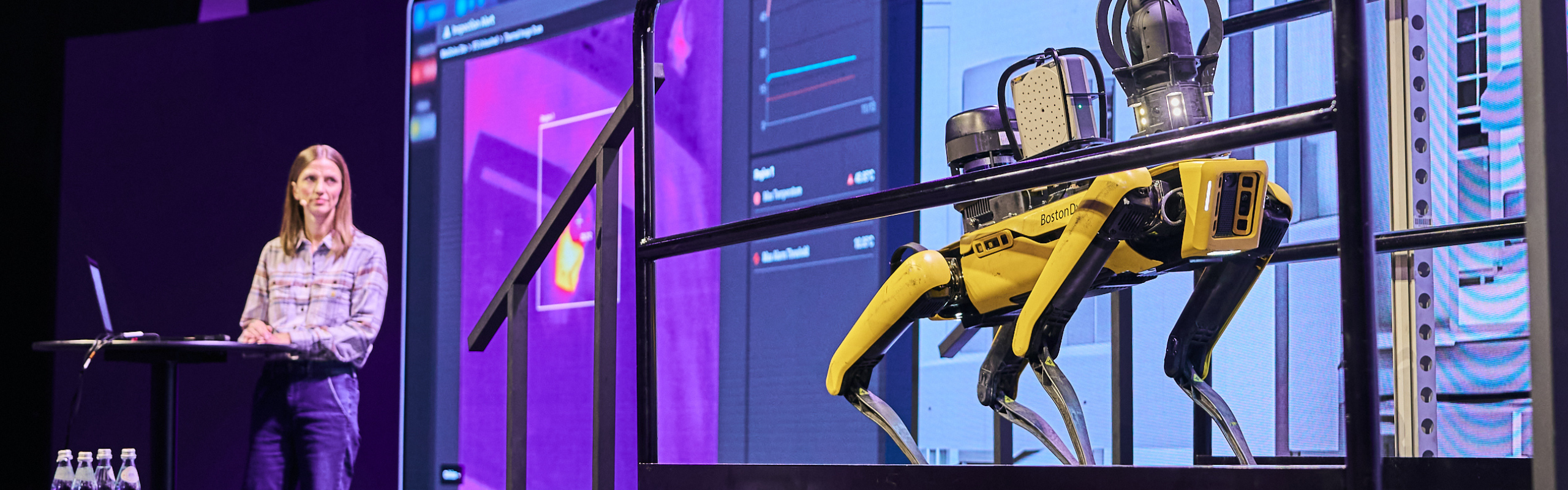
This was the moment that personally impressed me the most. The live demo with the Spot robot showed very tangibly how far we have come from a world where industrial robotics are discussed only on slides. Spot, a four-legged platform capable of moving autonomously around facilities, was presented as an extension of the IFS.ai system.
The robot can perform autonomous inspections: using thermal cameras it detects overheating equipment, listens for leaks, reads analogue gauges, checks indicator lights, and identifies spilled substances or voltage anomalies. The collected data is sent instantly to IFS.ai, where agentic AI analyses it, assesses the risk and, if necessary, automatically generates a service order or triggers preventive action.
Sitting in the audience and watching the robot move freely across the stage, I had a very strong sense that this is no longer a vision of the future, but a real tool that we will soon see in power plants, refineries, and factories also in our part of the world.
Image credit: IFS / IFS Industrial X Unleashed 2025
The joint solution from IFS and Boston Dynamics is primarily intended to improve safety by reducing human presence in hazardous zones, increase efficiency through faster decision-making, and boost the availability of critical assets through a predictive approach to failures. Target customers include, among others, the energy sector, mining, manufacturing plants, and operators of critical infrastructure.
1X Technologies humanoids: a new full-time employee on the shop floor
While Spot showed how far mobile robotics is already able to take work off people’s shoulders, the partnership with 1X Technologies touched on a vision of the future in which humanoid workers operate side by side with humans.
IFS and 1X announced a strategic collaboration under which the humanoid NEO is to be introduced into industrial environments as a robotic worker managed directly from IFS.ai.
The joint concept assumes that in the coming years, the size of the industrial workforce will be measured not only in human full-time employees, but also in the number of AI agents and robots. Plants that today struggle to operate with 300 people are ultimately expected to rely on an ecosystem of as many as 3,000 “workers”: human experts, digital agents, and humanoids performing physical tasks, including in hazardous or hard-to-reach environments.
Looking at this from the perspective of the conversations we have in Poland, it is clear that this direction will spark both great interest and questions around skills, safety, and responsibility. Industrial X Unleashed, however, showed that the discussion is no longer taking place only in laboratories, but increasingly on real factory floors.
The joint pilot programme is set to involve selected companies from sectors such as manufacturing, energy, and aviation. Commercial availability of solutions based on humanoids is planned for 2026.
Siemens and IFS: AI for the autonomous power grid
Another highlight for participants of IFS Industrial X Unleashed was the collaboration with Siemens, focused on transforming power grids.
IFS and Siemens will combine their strengths: on the one hand Gridscale X and Siemens’s experience in network and infrastructure planning, and on the other IFS.ai and solutions for asset management, investment planning, and field service operations.
The goal is to create a pathway to an autonomous grid capable of independently balancing the growing share of renewables, managing ageing infrastructure, and responding to increasingly frequent weather extremes. The integrated platform is intended to connect the engineering perspective with the business and financial perspective, and to translate long-term investment decisions into concrete work orders for field teams.
What has been emphasised is that the solution is to be modular and ready for cloud deployments without the need to rip and replace existing systems. From my point of view, this is also an important signal for companies in Poland that would like to benefit from modern solutions but are not ready to completely overhaul their system landscape. The collaboration is expected to benefit not only grid operators, but also energy producers, large industrial plants, and other organisations that depend on reliable infrastructure.
The Industrial AI ecosystem: from labs to plants
Beyond the partnership announcements themselves, Industrial X Unleashed also served as a stage for the broader ecosystem of advisors and integrators. Speakers included representatives of PwC, Accenture, Deloitte, Microsoft, MIT CISR, and Siemens Grid Software, among others.
From a participant’s perspective, it was very clear that without cooperation between technology vendors, consultants, and integrators, it will be difficult to talk about real industrial transformation. Presentations frequently addressed topics related to infrastructure, data management, regulations, and, in particular, the massive need to reskill the workforce.
On the IndustrialX.ai website, the organizer summarises the event format as a combination of product launches, “AI in action” demos, and strategic discussions about the future of work in industry. The programme was dominated by themes such as agentic AI, robotics, and physical AI, but the resilience of supply chains, infrastructure modernisation, and responsible deployment of new technologies were also recurring topics.
As a participant, I had the impression that these three elements – product, demo, and strategy – were indeed well balanced. On the one hand, you could see concrete solutions in action; on the other, there was still room for broader reflection on how the labour market and business models will change.
What comes after Industrial X Unleashed?
Judging by the scale of the partnerships and scenarios presented, Industrial X Unleashed was more than just a product conference. IFS is trying to position itself as a trusted category leader for Industrial AI, a platform through which, in the coming years, not only data from sensors and robots will flow, but also decisions around maintenance, investment planning, and workplace safety.
Image credit: IFS / IFS Industrial X Unleashed 2025
The joint projects with Anthropic, Boston Dynamics, 1X Technologies, and Siemens show that the company’s ambition is not merely to deliver yet another ERP system or AI module, but to truly connect the physical and digital layers – from a humanoid on the shop floor to an investment plan for the power grid.
For me personally, the trip to New York confirmed that the direction we are taking with myERP.global is the right one. More and more conversations about ERP systems, maintenance, and asset management will take place in the context of AI agents, robotics, and physical AI. Above all, IFS Industrial X Unleashed was a demonstration of one rather bold assumption: that the future of industry will be built not by individual tools, but by tightly integrated ecosystems of people, AI agents, and robots. And we want to stay close to these changes and continue to report on them for our communities – both in Poland and abroad.
MarekMac
You've seen 2 of 2 articles
That's all