

AI
Articles in the database: 8
Can Claude AI Be Your Programmer?
This employee will perform all repetitive tasks for you and, at lightning speed, without any breaks, finalize the concept as well as the initial stages of a technological project. Sounds familiar?
Using AI has become a habit for entrepreneurs — from popular conversational assistants (ChatGPT, Gemini) to advanced agents built into their supported ERP, WMS, CRM, and other systems. According to the latest No Fluff Jobs report, “AI in the IT Job Market,” as many as 68% of IT professionals use generative solutions every single day.
At the same time, the role of artificial intelligence has long surpassed passive advising in copywriting, content marketing, or basic IT. For several months now, AI has been becoming an active agent capable of performing tasks on a computer. Anthropic remains a pioneer in this area, developing its Claude model to achieve the greatest possible autonomy.
Claude Can Control Your Computer
Claude is an autonomous AI agent that can step outside the browser window, reach for the mouse and keyboard, and actually make changes in your separate applications. Using a feature called “computer use”, Claude views a screenshot of the computer and interprets it. Then the magic happens: opening applications, clicking through various functions, and executing commands. Moreover, API integration is not even necessary, which provides a massive advantage when working with accounting systems or official government portals.
This functionality can be utilized in programming. Claude Code then becomes an advanced “pair programming” partner, helping, among other things, with unit code creation and refactoring. Thus, it can significantly accelerate programming right from the concept stage. It almost instantly translates the client’s general business requirements into a database structure and the final technological stack.
Opportunity or Threat?
Let’s return for a moment to the No Fluff Jobs report. Respondents admitted that despite the enormous potential and dynamic development of artificial intelligence, they genuinely fear for their job security. Furthermore, as many as 40 percent of Polish IT specialists declare a lack of trust in AI technology.
Among the main concerns hindering the complete handover of control to artificial intelligence is the risk of errors in generated code, which was pointed out by as many as 60 percent of respondents. Moreover, doubts regarding the security of company data still persist. Some experts continue to highlight the risk of leaks due to the unpredictable nature of LLM models.
On the other hand, for the SME sector, models like Claude are a true financial revolution. For the price of a monthly subscription (starting at $20, depending on the selected version), small organizations can secure automation capabilities at least on par with a junior-level position.
Will Claude Push The Programmer Out From Behind The Desk?
Claude’s functionalities, especially in “computer use” mode, may cause some employees to feel replaced to some extent. However, the reality is slightly more optimistic. Claude might be able to create a simple recruitment application. Yet, it will not lead the implementation of a massive, deeply integrated WMS system. For that, human hands are still needed.
Claude has probably already settled onto the desks of many specialists, but it has become more of a desk-mate than a permanent replacement. Companies still need experts who are able to control the code and apply corrections. Therefore, knowing Python or JavaScript — even at a basic level — remains immensely valuable on a CV. Thanks to this, a specialist no longer blindly copies code but can additionally improve it.
One key thing is changing — employees cannot pretend that AI isn’t around them. They, too, should learn to supervise LLM models and manage agents.
It is worth keeping in mind expert recommendations and the EU’s AI Act. Implementing artificial intelligence should begin with automating the lowest-risk processes. This will allow for discovering the strengths and weaknesses of the solution while the model operates within a designated permission “sandbox.”
Source: https://nofluffjobs.com/insights/ai-na-rynku-pracy/, businessinsider.com.pl

KajaGrabowiecka

Artificial Intelligence in ERP Systems. Which AI Solution Should Businesses Choose?
Today, AI is no longer just a trend but a tool from which companies expect measurable benefits. As a result, managers are no longer asking whether an ERP system includes AI features, but rather what type of AI capabilities it offers. In this article, we organize the market and highlight the differences that matter for decision-makers.
Just 2–3 years ago, artificial intelligence in business systems was often treated as an “add-on” to sales presentations. Today – especially from the perspective of CFOs and IT managers – it is an area that is rigorously evaluated. This is also reflected in the findings of the “Cyfrowy Menedżer” report prepared by myERP, which clearly shows a shift toward a “prove it” mindset. AI is expected to deliver results only when a company has solid foundations in the form of high-quality data and clearly defined KPIs.
How to Compare AI Solutions in ERP?
The biggest trap in implementing AI within ERP systems is assuming that an LLM can compensate for disorganized data and processes. From a purchasing perspective, it is better to treat AI as a productivity layer. Artificial intelligence shortens working time, supports decision-making, and automates routine tasks – but it also requires high-quality input data.
IT and finance departments should pay attention to three key aspects:
Scope of process interventionSome AI solutions act only as informational assistants, providing summaries or insights from reports. Others can perform actual actions within the system – such as setting credit limits or issuing documents.
Sources of generated responsesSome solutions rely exclusively on internal company data, reducing the risk of AI “hallucinations.” Others – especially generative AI tools – require users to define the sources the LLM can access.
Costs and technical conditionsSome AI features are included in ERP systems at no additional cost. Others offer advanced capabilities available through paid options.
AI Assistants in ERP Systems
The most visible form of AI for users is conversational assistants. These solutions enable interaction with ERP systems using natural language, inspired by tools like ChatGPT or Gemini. They also help accelerate onboarding for new employees.
ChatERP from Comarch
ChatERP is a built-in chat assistant that allows users to interact with ERP in natural language. Ultimately, it is intended to cover both on-premise and cloud versions of all Comarch ERP systems. Currently, it is available in BETA.
Its functionality includes:
Access to company data available in the system
Data analysis and reasoning
Suggesting system features
Executing tasks on user request
A key aspect is the ability to perform business operations such as setting credit limits or issuing invoices. In practice, this requires strict permission and audit mechanisms. Without them, the risk of incorrect commands increases.
Comarch ensures the protection of personal and sensitive data in ChatERP. Queries and responses may be processed by technology subcontractors, but the AI should not disclose business secrets. Still, companies with high security requirements should formally define data-sharing rules before implementation.
Genius by Asseco Business Solutions
In terms of declared functionality, Genius is closer to the concept of a digital coworker that monitors tasks, supports decisions, and suggests actions. According to Asseco BS, it notifies users about pending decisions and tasks, answers ERP-related questions, and supports processes such as orders, invoices, and warehouse documents.
Additionally, based on user-provided context, the assistant can deliver actionable recommendations.
This approach is enhanced by two important elements:
Adaptive interface – AI analyzes user behavior and suggests changes to layout, menus, or screen elements, implemented only after user approval.
Analytical layer – Genius provides intelligent insights based on real-time ERP data.
MAiA in Monitor ERP System
Monitor ERP includes its own AI assistant that “structures, compiles, and analyzes data.” Its main goal is to handle time-consuming tasks. MAiA is not just a chatbot – conversational mode is only one interface.
It also works through automated summaries and analyses embedded directly in business processes, similar to how Gemini Pro summarizes documents in Google Drive.
Importantly, Monitor’s AI relies exclusively on internal business data, ensuring data integrity and control. MAiA also supports text-related tasks – summarizing notes, translating emails, and refining communication tone.
MAiA is available in two versions:
Basic – included for all customers
Pro – available with a monthly per-user fee
The Pro version is initially offered as a free trial. Monitor ERP continues to develop AI features and actively collects user feedback via its Ideas Forum.
AI Application Ecosystem Instead of a Single Feature
An interesting approach comes from Proalpha, which in 2025 introduced its Industrial AI platform. This is a catalog of over 30 AI applications covering core processes – from procurement and production to service.
The platform integrates AI solutions from Empolis and Nemo and is built in a SaaS architecture, enabling smooth integration with both Proalpha’s ecosystem and third-party systems.
Nemo’s AI capabilities include:
Identifying correlations and anomalies in processes
Defining recommended actions
Evaluating optimization potential in financial terms
In this platform-based approach, AI becomes the “engine” of data integration and analytics.
For decision-makers, two key implications stand out:
Data processing approach – Industrial AI handles both structured (tables) and unstructured data (documents, notes), turning hidden knowledge into actionable insights
Automated recommendations – which can be implemented based on diagnosis and trend forecasting
The Microsoft Ecosystem and AI in ERP
A unique position in the market is held by Microsoft Dynamics 365 – a scalable ERP/CRM platform deeply integrated with other Microsoft services.
Implementations are delivered by multiple myERP partners, including companies such as Companial, Integris, MS POS Poland, xalution Group, IT.integro, and Solemis.
Copilot
Microsoft has embedded Microsoft Copilot in ERP systems in two ways: as a conversational assistant and as embedded functionality within system features.
Key capabilities in Dynamics 365 Business Central include:
Conversational guidance on system functionality
Data analysis using filters and sorting
Creation of sales documents (quotes, orders, invoices)
Marketing content generation
E-document mapping
Bank reconciliation
Document numbering automation
Product substitution suggestions
Order processing automation
Power BI
Many organizations want ERP data to be consumed in a self-service analytics model. In this context, Copilot in Microsoft Power BI provides significant value:
Fast creation and modification of reports and visualizations
Automatic report summaries
Conversational interaction with data
However, Copilot in Power BI is a paid feature (Fabric or Premium). Additionally, organizations must ensure high data quality for AI to function effectively.
AI in ERP – What Should You Choose?
There is no single “best AI” solution for all organizations. The right choice depends on the dominant challenge within the company – whether it is low user productivity, the need for stronger financial control, or real-time production optimization.
Key takeaway:AI in ERP should not be treated as a standalone feature, but as a strategic layer that enhances how people work with data, processes, and decisions.
KajaGrabowiecka

Reaching for the Sky and Beyond: The New Digital Mandate for Commercial Aerospace in 2026
Faced with rising cybersecurity threats and persistent supply chain shortages, airlines and regulators alike are demanding a new level of digital resilience. In 2026, success will hinge on closing critical security gaps and more outside the box digital thinking on supply chains to mitigate parts issues, including a promising outlook for 3D printing for on-demand parts.
A tightly stretched human workforce will get some relief as Agentic Industrial AI becomes digital co-pilots in maintenance hangars.
Meanwhile, reusable rockets opening the door for a new space aftermarket, expanding the very concept of MRO – The path to new markets means the sky isn’t the limit anymore!
Cybersecurity grows in importance to defend globally critical infrastructure by closing the gap in the middle
The entire commercial aviation network is critical, high-value infrastructure that ensures the effective movement of people and goods around the world, think transportation of vaccines. The industry’s vulnerability to cyberattacks and their ability to cause widespread disruption has been underscored by recent examples. Thales figures found a 600% increase in ransomware attacks in the aviation sector between 2024-2025. Just look to the ransomware attack in September 2025 that crippled check-in systems across multiple major European hubs such as Brussels, London and Berlin as a perfect example of how a single vendor compromise can cascade into continental-scale disruption.
Any cybersecurity incidents that impact commercial aviation not only expose personal data and damage passenger trust, but they can also cripple the global supply chain.
At issue is the fact that aviation is still only partially digitally mature. While only partially true, older mainframe systems are often seen as impervious to cyberattack the better modern systems are built for security. The true vulnerability lies in the “middle section” where airline, aircraft, and ground systems have been partially modernized but are not fully up to date with modern cybersecurity practices.
In the year ahead, airlines and regulatory bodies, motivated by recent attacks and the essential role of aviation, and consequential potential targeting by state-sanctioned actors, will mandate a significant push for digital modernization across the entire industry. This will compel all major airlines and airports to implement up-to-date, modern cybersecurity practices for all operational systems, closing the “middle section” gap to counter potential threats.
This is where airline operators need seamless agility and resilience to stand a chance in the cybersecurity battle. Any software provider to airlines and MROs must constantly adopt a clear security posture, constantly addressing vulnerabilities with frequent updates using an evergreen approach and ideally, designing out vulnerabilities from the beginning.
3D printing provides becomes part of the answer to global supply chain constraints
Supply chain challenges for spare parts availability persist in commercial aviation driving it back up to the top of the list of issues facing the aviation maintenance industry and leading airlines and air operators to think outside the box and adopt innovative strategies to maintain operational readiness. One potential solution has been to use Parts Manufacturer Approval (PMA) parts, but some airlines face considerable hurdles here as lessors often refuse to allow OMA parts on their aircraft. Even if used as a stop-gap, airlines are forced to swap them out at time of lease return, meaning they are still subject to the main suppliers’ limitations. However, other parts supply solutions are on the horizon.
There are promising signs ahead of ongoing efforts by FAA and EASA regulators to clarify how 3D printed parts can be used in certain applications. Additive manufacturing, combined with the digital thread, could help solve supply chain bottlenecks by allowing parts to be produced quickly and in proximity to where they are needed. In particular, this technology offers a solution for maintaining older aircraft more efficiently, as digital files for specific parts replace the need to store molds and retool assembly lines that may have been decommissioned years before.
Following a formal loosening of regulatory constraints, 3D-printed parts will become a mainstream, more accepted solution. The ability to rapidly produce both non-critical and older aircraft components will drastically streamline MRO processes and establish 3D printing as a driver of supply chain resilience in an industry that continues to feel the pain of supply chain issues. We are already seeing this shift with certified 3D-printed engine components and heat exchangers that handle super-complex geometries not achievable through traditional manufacturing, such as those on the GE Catalyst turboprop engine and the 3-D printed air-to-air heat exchanger flying on the Cessna Denali.
Industrial AI and digital co-pilots in maintenance hangars will revolutionize maintenance troubleshooting
If there is one thing that rivals supply chain challenges for the top of the issues list in aviation maintenance, it is the skilled workforce shortage. And it’s abundantly clear that technician shortages will not be solved in the next 12 months. Despite technician certifications rising, The Pipeline Report from the U.S. Aviation Technician Education Council (ATEC) and Oliver Wyman shows increasing demand and projected retirements are expected to leave commercial aviation with 10% fewer certified mechanics than needed in 2025.
So, the question becomes, how can we help the technicians we do have, do more? One answer is to digitally augment the maintenance technicians to improve overall efficiency. This is where applications of Agentic AI are stepping up to the plate. One of the most impactful applications of this AI will be the creation of a “troubleshooting agent” to support maintenance technicians. This generative AI co-pilot will be able to navigate the extraordinary complexity of maintenance documentation, such as Airworthiness Directives (ADs) and Service Bulletins (SBs).
The ideal agent will be able help navigate complex reference documentation like AMMs, CMMs, troubleshooting manuals, or the IPC while pulling up pertinent SBs or ADs. The co-pilot could suggest it’s a potential recurring fault and surface which repairs failed to work previously. Such a co-pilot could in another scenario suggest the likely candidates for troubleshooting tasks including historic success rates and time to execute. It could even request the required parts automatically, so they are there waiting.
In the year ahead, expect troubleshooting agents to move out of the pilot phase and into deployment within the maintenance operations of airlines and MROs. These agents will serve as a digital co-pilot that enhances the productivity of the existing, experienced workforce, while also helping close the knowledge gap for newer technicians.
The dawn of the space aftermarket!
Looking further skyward, an aftermarket opportunity is emerging that goes beyond Earth’s stratosphere. The new aftermarket is being driven by a proliferation of satellites that have been deployed for communication, observation and scientific purposes, combined with the rise of reusable vertical-landing rockets such as the SpaceX Falcon 9 and the newly developing Starship. Commercial space tourism is now adding a third catalyst, with reusable spaceflight vehicles that must be maintained to rigorous safety and compliance standards between flights. Together, these shifts are creating an entirely new MRO market for launch platforms themselves, which now require a formal sustainment process rather than simple disposal after a single use.
These launch vehicles are increasingly designed for reusability, which means they now require a formal sustainment process rather than simple disposal after a single use. This creates a new MRO market for launch platforms themselves.
For the most part, orbital vehicles have been treated as disposable assets with a finite operational life. Bringing spacecraft back down to Earth has not been feasible, and sending repair systems up has been equally impractical. The advent of self-healing materials is beginning to shift this paradigm by enabling spacecraft to autonomously repair micro-cracks and structural degradation in orbit, as demonstrated in recent aerospace research on self-healing composites. At the same time, dramatically lower launch costs mean that on-orbit servicing and repair are becoming feasible for the first time.
Launch and space-platform MRO is rapidly emerging as the next frontier. Blue Origin’s multi-use Blue Ring platform illustrates how reusable vehicles will create entirely new sustainment markets. In parallel, NASA’s On-Orbit Servicing, Assembly and Manufacturing (ISAM) framework highlights how satellites and launch systems will require formal sustainment infrastructures rather than being treated as disposable.
Research shows the Space Logistics Market Size will grow to $19.8 billion by 2040, with large growth driven by on-orbit servicing, assembly and manufacturing, as well as last-mile logistics. The ripple effect over the coming years is that these once disposable space assets will require sustainment and support strategies to maximize availability, efficiency, and further reduce the costs of space operations. This means maintenance needs to be built into the asset management lifecycle. No matter the form the servicing takes, this shift means that new systems will need to be implemented to manage the ongoing lifecycle management of these assets not previously required. Manufacturers must make sure vehicles are ready not just for use, but for re-use and critically, are 100% operational when they are required.
The modernization mandate to chart a course for commercial aviation success
The outlook for commercial aviation in 2026 is clear: digital resilience isn’t a buzzword, it’s a key path forward. Facing critical cybersecurity threats and persistent supply chain bottlenecks, the industry is accelerating its digitalization out of necessity, not choice. Securing a vulnerable digital infrastructure is essential for out of the box approaches to parts shortages such as 3D printing to reach their full potential, giving airlines the agile power to create parts on demand.
Hand in hand – the journey goes up, up and away!
An even more exciting shift is human-tech collaboration taking flight. With technician shortages here to stay, Agentic AI will emerge as a digital co-pilot, boosting efficiency in maintenance hangars by instantly mastering complex technical data.
Looking even higher, the growth in commercial space continues to open new opportunities for aerospace companies.
Author:
Rob Mather, Vice President, Aerospace and Defense Industries
As Vice President, Aerospace and Defense Industries, Rob Mather is responsible for leading the charge on IFS’ global A&D industry marketing strategy, while also supporting product development, sales and partner ecosystem growth. Rob has over 15 years’ experience in the A&D sector, starting out in the field and having held a number of strategic R&D, Presales and Consulting positions at IFS, Mxi Technologies and Fugro Aviation. Prior to his current position, Rob was instrumental in building and leading the global A&D Presales Solution Architecture team at IFS, playing a key role in a number of customer success engagements at some of the top names in commercial aviation and defense. He holds a degree in Aerospace Engineering from Carleton University in Ottawa, Canada, where he currently resides.

IFS

AI That Puts Money Back Into Companies. A Conversation With Matt Kempson, COO AI at IFS, During Industrial X Unleashed
When I sat down with Matt Kempson, COO AI at IFS, during IFS Industrial AI X Unleashed, I immediately felt that I was about to hear something more than corporate slogans about artificial intelligence. Matt talks about AI in a deeply practical, almost operational way – always from the perspective of real problems that can be solved here and now. And indeed, this conversation turned out to be one of the most concrete I have conducted in recent years.
Industrial X Unleashed – where AI met real industry
Industrial X Unleashed was a one-day event held by IFS on November 13, bringing together industry leaders, customers, and experts working at the intersection of industrial operations and artificial intelligence. The conference did not focus on futuristic visions, but on practical applications of AI – the kind that are already transforming how manufacturing, service, energy, and logistics companies operate.
Throughout this intensive day, IFS presented both its current AI strategy and concrete, fully functioning solutions used by customers today. Discussions focused on intelligent inventory management, digital workers supporting field technicians, supply chain automation, and tools that reduce diagnostic and repair times.
It was also an excellent opportunity to talk about the challenges faced by companies in Poland and around the world – from the shortage of skilled engineers to pressure to reduce operational costs and the growing need to automate processes.
It was in this context that my conversation with Matt Kempson, COO AI at IFS, took place.
The biggest opportunity for AI in industry – where companies could gain the most today?
When I opened the conversation by asking Matt about the biggest opportunity for AI across the industries IFS serves, I expected to hear about predictive maintenance, process automation, or intelligent planning. Instead, Matt began with a topic that is painfully down-to-earth – and financially enormous: inventory.
And not “inventory” in the sense of having a slightly better-stocked warehouse, but in the sense of millions in frozen capital that companies often don’t even know about.
Matt stated it clearly:
Block Quote
Listening to him, I immediately thought of many Polish companies investing in machines, automation, and ERP systems – while inventory quietly drains their cash flow in the background.
Then, he took it further:
Block Quote
It was at this point that I fully understood what Matt meant when he described inventory as “the most underestimated domain” in industrial AI. Not advanced predictive models, not robotics – but real-time visibility, normalization, and understanding of whata company actually owns.
Matt also emphasized a crucial point: inventory is the area where AI delivers the fastest ROI. Often from day one.
And maybe, as Matt implicitly suggested, the perfect AI use case many companies are searching for… is already lying on a shelf in their warehouse.
How companies accelerated AI adoption – what separated leaders from those stuck in pilots?
My second question to Matt addressed a problem I see constantly in Poland: companies begin AI initiatives, run pilots… and stay stuck at that stage. Matt immediately acknowledged that this wasn’t just a local issue:
Block Quote
He explained that AI adoption always began with people – and that organizations could not bypass this phase:
Block Quote
He highlighted a step that most companies overlook:
Block Quote
Only then, Matt said, should companies move toward quick wins using ready-made solutions:
Block Quote
The most powerful statement came when he explained why companies get stuck:
Block Quote
Then came a warning every decision-maker should remember:
Block Quote
This part of the conversation showed me clearly that AI leaders weren’t distinguished by the tools they used – but by the pace and order in which they adopted them.
What could IFS change in the coming year – the three AI developments Matt was most excited about
When I asked Matt which upcoming AI innovations at IFS excited him the most,he didn’t hesitate: “Let me give you three.”
IFS.AI Logistics – a true “game changer” for supply chain
The first area was the upcoming relaunch of IFS.AI Logistics, enhanced by the acquisition of Seven Bridges.
Block Quote
Digital workers – more work done, less paperwork
Second were the digital worker capabilities demonstrated during IFS Loops:
Block Quote
IFS Nexus Black – a true inventory revolution in just six weeks
The final area was clearly the one closest to Matt’s heart: inventory.
Block Quote
And then he delivered the sentence that shows just how transformative AI has become:
Block Quote
At that moment, it became clear that we weren’t talking about the future – but about solutions ready to reshape operations right now.
Why AI has become a strategic tool for industry – summary of my conversation with Matt Kempson
As we wrapped up, I asked Matt about the broader meaning of AI for companies – beyond individual use cases. His answer captured perfectly the essence of our discussion.
He stressed that companies often hunt for savings at the end of the year in the worst possible places – by cutting staff or squeezing suppliers. Meanwhile, the real opportunity lies elsewhere:
Block Quote
Then came the statement that stayed with me long after our conversation:
Block Quote
This made me realize that our discussion was not about the future – but about very real, very urgent decisions companies can make right now. About the money they lose every day by waiting. And about the competitive edge earned by those who don’t delay.
That’s why this conversation with Matt was one of the most eye-opening and concrete discussions I’ve had this year.

MarekMac

IFS Industrial X Unleashed in New York: AI Hits the Shop Floor
On 13 November, in New York’s Tribeca district, at the Spring Studios venue, IFS hosted Industrial X Unleashed – a one-day event that set out to define a new standard for so-called Industrial AI, that is, artificial intelligence designed not for offices, but for factories, power grids, and critical infrastructure.
For me, the trip was special for another reason as well. It was the first time that myERP.global appeared at such a large event abroad, and I was representing us in New York on my own. The very sight of Spring Studios filled with partners, customers, and IFS teams was truly impressive. The scale of the event, the polished visual design, and the very well thought-out agenda made it clear from the outset that this was not just another AI conference, but a showcase of real implementations and the direction in which industry is heading.
On stage we saw representatives of Anthropic, Boston Dynamics, Microsoft, PwC, Siemens, as well as many customers from industries such as energy, manufacturing, aviation, and telecommunications. The organizer, IFS – a provider of Industrial AI-class software – promised not yet another AI show, but concrete, working implementations. From the perspective of someone who talks every day with companies implementing ERP systems and AI solutions, that was exactly what I wanted to see there.
From hype to industrial reality
The IFS Industrial X Unleashed conference opened with a keynote from Mark Moffat, CEO of IFS. He outlined a vision in which the real return on investment in AI is not created in presentations, but on production lines, in transmission networks, and out in the field. That is where around 70 percent of the global workforce is employed, not in office open spaces. Listening to this from the audience in New York, I felt it resonated strongly with what we hear from our partners and customers in Poland: AI only makes sense when it touches real processes, not just slides and prototypes.
Image credit: IFS / IFS Industrial X Unleashed 2025
At the center of this vision is IFS.ai, a platform intended to act as an operating system for industry, bringing together people, digital agents, and robots in a single flow of data and decisions. In IFS’s own language, it is a journey from signal to action: data from sensors or cameras, analysis by AI agents, and then an immediate decision and work order for technicians, robots, or both at once. Looking at this from the perspective of the market we describe on myERP.global, it is clear that precisely this coherence between the IT layer, the OT layer, and the physical world will, in the coming years, distinguish the most advanced companies.
Anthropic and Resolve: multimodal AI for people in the field
One of the most talked-about announcements was the strategic partnership between IFS Nexus Black and Anthropic, the creator of the Claude models. The result of this partnership is Resolve, a new class of Industrial AI tool that goes directly into the hands of technicians and maintenance staff.
Image credit: IFS / IFS Industrial X Unleashed 2025
From my point of view, this is a very important direction. In conversations with manufacturing and service companies, I often hear that the biggest challenge is no longer analytics itself, but delivering the right guidance at the right moment to the person who is physically at the machine or installation. And this is precisely where Resolve makes a difference.
The tool can analyse many different types of data at once: video from a technician’s phone, audio recordings, temperature and pressure readings, or complex installation schematics. On this basis it predicts failures, recommends spare parts, optimises work schedules, and automatically documents completed tasks, including through speech recognition and transcription of voice reports.
On stage, they showed, among others, the example of Scottish distillery William Grant & Sons, the producer of Grant’s whisky and Hendrick’s gin. Before Resolve was implemented, as many as around 38 percent of repairs were emergency in nature. Today, thanks to failure prediction and better planning, the plant has significantly reduced unplanned downtime, and the annual financial benefits are estimated at around 8.4 million pounds. Listening to this story, I thought that we would soon see similar case studies in the Polish market, especially among companies that are already investing in predictive maintenance.
Kriti Sharma, head of Nexus Black, stressed from the stage that in industries where “sometimes a human life is at stake”, the priority must be not only the power of the model, but also the safety and responsibility of AI. This is exactly what Anthropic is expected to bring to the IFS ecosystem, alongside purely technological capabilities. The theme of responsible AI implementation ran throughout the event and, for me, was one of the most important signals for the market.
Boston Dynamics: Spot the robot as an autonomous inspector
Another pillar of IFS Industrial X Unleashed was physical AI – the combination of AI agents with robots. IFS announced a partnership with Boston Dynamics, the global leader in mobile robotics.
Image credit: IFS / IFS Industrial X Unleashed 2025
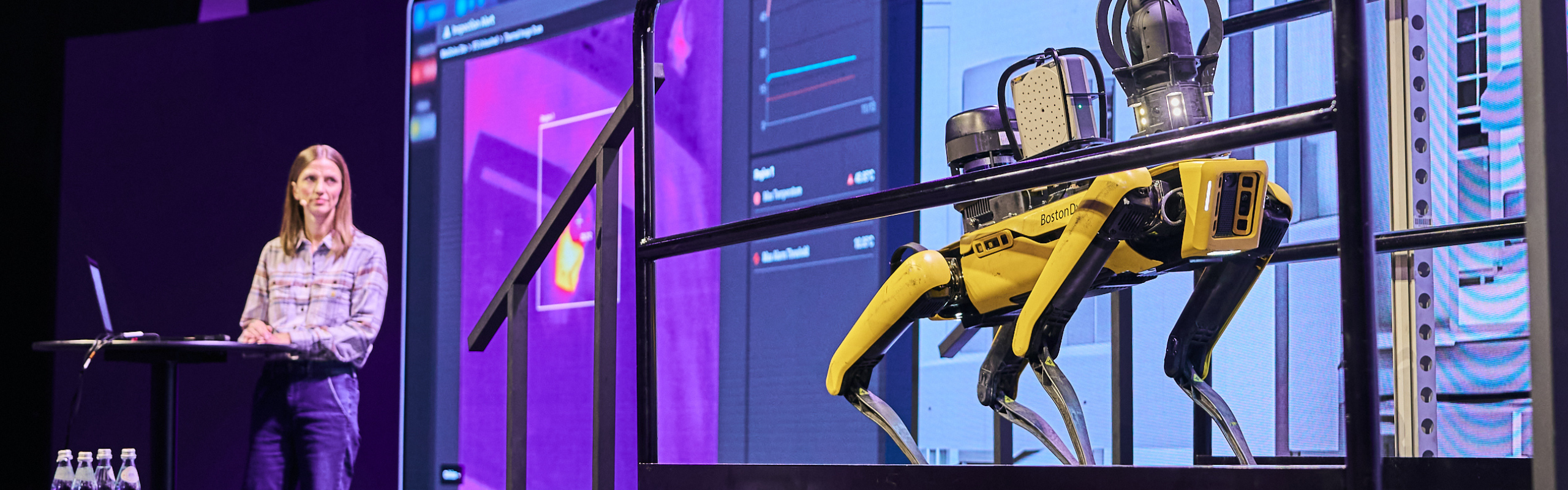
This was the moment that personally impressed me the most. The live demo with the Spot robot showed very tangibly how far we have come from a world where industrial robotics are discussed only on slides. Spot, a four-legged platform capable of moving autonomously around facilities, was presented as an extension of the IFS.ai system.
The robot can perform autonomous inspections: using thermal cameras it detects overheating equipment, listens for leaks, reads analogue gauges, checks indicator lights, and identifies spilled substances or voltage anomalies. The collected data is sent instantly to IFS.ai, where agentic AI analyses it, assesses the risk and, if necessary, automatically generates a service order or triggers preventive action.
Sitting in the audience and watching the robot move freely across the stage, I had a very strong sense that this is no longer a vision of the future, but a real tool that we will soon see in power plants, refineries, and factories also in our part of the world.
Image credit: IFS / IFS Industrial X Unleashed 2025
The joint solution from IFS and Boston Dynamics is primarily intended to improve safety by reducing human presence in hazardous zones, increase efficiency through faster decision-making, and boost the availability of critical assets through a predictive approach to failures. Target customers include, among others, the energy sector, mining, manufacturing plants, and operators of critical infrastructure.
1X Technologies humanoids: a new full-time employee on the shop floor
While Spot showed how far mobile robotics is already able to take work off people’s shoulders, the partnership with 1X Technologies touched on a vision of the future in which humanoid workers operate side by side with humans.
IFS and 1X announced a strategic collaboration under which the humanoid NEO is to be introduced into industrial environments as a robotic worker managed directly from IFS.ai.
The joint concept assumes that in the coming years, the size of the industrial workforce will be measured not only in human full-time employees, but also in the number of AI agents and robots. Plants that today struggle to operate with 300 people are ultimately expected to rely on an ecosystem of as many as 3,000 “workers”: human experts, digital agents, and humanoids performing physical tasks, including in hazardous or hard-to-reach environments.
Looking at this from the perspective of the conversations we have in Poland, it is clear that this direction will spark both great interest and questions around skills, safety, and responsibility. Industrial X Unleashed, however, showed that the discussion is no longer taking place only in laboratories, but increasingly on real factory floors.
The joint pilot programme is set to involve selected companies from sectors such as manufacturing, energy, and aviation. Commercial availability of solutions based on humanoids is planned for 2026.
Siemens and IFS: AI for the autonomous power grid
Another highlight for participants of IFS Industrial X Unleashed was the collaboration with Siemens, focused on transforming power grids.
IFS and Siemens will combine their strengths: on the one hand Gridscale X and Siemens’s experience in network and infrastructure planning, and on the other IFS.ai and solutions for asset management, investment planning, and field service operations.
The goal is to create a pathway to an autonomous grid capable of independently balancing the growing share of renewables, managing ageing infrastructure, and responding to increasingly frequent weather extremes. The integrated platform is intended to connect the engineering perspective with the business and financial perspective, and to translate long-term investment decisions into concrete work orders for field teams.
What has been emphasised is that the solution is to be modular and ready for cloud deployments without the need to rip and replace existing systems. From my point of view, this is also an important signal for companies in Poland that would like to benefit from modern solutions but are not ready to completely overhaul their system landscape. The collaboration is expected to benefit not only grid operators, but also energy producers, large industrial plants, and other organisations that depend on reliable infrastructure.
The Industrial AI ecosystem: from labs to plants
Beyond the partnership announcements themselves, Industrial X Unleashed also served as a stage for the broader ecosystem of advisors and integrators. Speakers included representatives of PwC, Accenture, Deloitte, Microsoft, MIT CISR, and Siemens Grid Software, among others.
From a participant’s perspective, it was very clear that without cooperation between technology vendors, consultants, and integrators, it will be difficult to talk about real industrial transformation. Presentations frequently addressed topics related to infrastructure, data management, regulations, and, in particular, the massive need to reskill the workforce.
On the IndustrialX.ai website, the organizer summarises the event format as a combination of product launches, “AI in action” demos, and strategic discussions about the future of work in industry. The programme was dominated by themes such as agentic AI, robotics, and physical AI, but the resilience of supply chains, infrastructure modernisation, and responsible deployment of new technologies were also recurring topics.
As a participant, I had the impression that these three elements – product, demo, and strategy – were indeed well balanced. On the one hand, you could see concrete solutions in action; on the other, there was still room for broader reflection on how the labour market and business models will change.
What comes after Industrial X Unleashed?
Judging by the scale of the partnerships and scenarios presented, Industrial X Unleashed was more than just a product conference. IFS is trying to position itself as a trusted category leader for Industrial AI, a platform through which, in the coming years, not only data from sensors and robots will flow, but also decisions around maintenance, investment planning, and workplace safety.
Image credit: IFS / IFS Industrial X Unleashed 2025
The joint projects with Anthropic, Boston Dynamics, 1X Technologies, and Siemens show that the company’s ambition is not merely to deliver yet another ERP system or AI module, but to truly connect the physical and digital layers – from a humanoid on the shop floor to an investment plan for the power grid.
For me personally, the trip to New York confirmed that the direction we are taking with myERP.global is the right one. More and more conversations about ERP systems, maintenance, and asset management will take place in the context of AI agents, robotics, and physical AI. Above all, IFS Industrial X Unleashed was a demonstration of one rather bold assumption: that the future of industry will be built not by individual tools, but by tightly integrated ecosystems of people, AI agents, and robots. And we want to stay close to these changes and continue to report on them for our communities – both in Poland and abroad.
MarekMac
Power Platform – Practical benefits for businesses without coding
Companies are increasingly looking for ways to accelerate the digitalization of their processes without getting bogged down in lengthy and expensive IT projects. To meet these needs, Microsoft has created Power Platform – a suite of tools that includes Power BI, Power Apps, Power Automate, Power Pages, and Copilot Studio.
This platform enables rapid development of business applications, process automation, and data analysis, all without the need for large-scale IT initiatives. Its biggest advantage? Full integration with Microsoft 365 (Teams, Outlook, SharePoint) and Dynamics 365 (ERP, CRM). This means companies can build on their existing ecosystem and adapt it to current needs.
Why choose Power Platform?
By choosing Power Platform, organizations gain above all speed – solutions can be implemented in days or weeks, not months. Another key benefit is the low entry barrier: applications and automations can be created not only by developers but also by advanced business users. The platform offers flexibility in process customization, seamless integration with Dynamics 365, Microsoft 365, and other systems, as well as security backed by Azure cloud compliance standards.
Real-World applications
The true potential of Power Platform is best illustrated by real-life business scenarios. Companies use the platform to automate repetitive office tasks, such as copying data from emails or moving files to SharePoint. This saves hours of manual work and significantly reduces errors.
Many organizations build internal apps for employees – for handling vacation requests, expense tracking, or equipment management. Instead of endless email chains and Excel spreadsheets, processes are streamlined and accessible in a single app. Reporting in Power BI consolidates data from various sources and presents it in interactive dashboards, enabling decisions based on up-to-date information rather than static reports.
Electronic document workflows – like invoice approvals or purchase and investment requests – bring major time savings. Thanks to the integration of Power Apps and Power Automate, approval paths become transparent, and the entire process is shortened from days to hours. HR and IT chatbots support employees with basic requests, freeing up support teams to focus on more complex issues.
Power Platform is a great complement to ERP and CRM systems, allowing for flexible extensions without costly development. This could be, for example, an app for submitting customer data changes or automatically updating order statuses. In manufacturing and service companies, apps for handling breakdowns and complaints are popular – each case gets a status, a responsible person, and a deadline, which shortens response times and boosts customer satisfaction.
For project work, Power Platform supports task management and progress tracking through integration with Microsoft Teams. Field apps let employees collect data directly at the client site – even offline. Meter readings, sales visit reports, or health and safety inspections go straight into the system, eliminating paper forms and double work. In compliance and audit areas, the platform supports checklists and Power BI reporting, helping minimize non-compliance risks and making quality control documentation easier.
Benefits within the Microsoft ecosystem
The greatest strength of Power Platform is its integration with tools many companies already use. Teams becomes the central workspace, with apps and reports at your fingertips. Dynamics 365 can be easily extended with additional processes. Outlook and SharePoint work seamlessly with Power Automate to organize documents and communications. And Azure cloud ensures scalability and regulatory compliance.
A natural step in digital transformation
Power Platform is a tool that helps boost efficiency and speed up digital transformation. Its key advantage is the ability to start with a single, simple solution – like electronic invoice workflow, an HR chatbot, or a sales dashboard in Power BI – and gradually expand your ecosystem as your needs grow.

PiotrBącała

Agentforce Cuts Sales Quoting Time by 75%, Dramatically Reduces Manual Work for Reps
Quoting should be simple. But for most sales reps, it’s anything but. They are forced to hunt for the right combination of SKUs, interpret complex pricing rules, check legal terms, and wait on approvals, all while under pressure to move fast. A single mistake can lead to delays, rework, or worse: sending an incorrect quote. This inefficiency directly slows down deal velocity and revenue.
That’s why Salesforce is introducing Agentforce for Revenue. It brings digital labor that takes on routine work like quoting, follow-ups, and data entry, so every rep can focus on building relationships and driving revenue. Embedded in Revenue Cloud, this solution combines the power of humans and AI agents to streamline the entire quote-to-cash process, from quoting and contracting to ordering and invoicing, with greater speed, accuracy, and confidence.
Instant quotes with Agentforce for Revenue
Agentforce empowers reps to create accurate, customized quotes in seconds. Reps simply describe what they need — like “Quote a new generator with the usage-based energy pack” — and Agentforce instantly generates the quote, automatically pulling the correct products, pricing, and terms. Salesforce is already using Agentforce internally and has seen a 75% decrease in quoting time along with an 87% reduction in clicks for its own sales team.
And it’s not just Salesforce seeing results. Agentforce is designed to deliver quoting speed and accuracy to customers across any industry, from manufacturing to healthcare. Take AdMed, Inc., a leader in pharmaceutical and biotech training, which is now leveraging Revenue Cloud to modernize its sales process.
“Revenue Cloud is transforming the way we do business,” said Bill Francy, President of Client Services at AdMed, Inc. “We’re currently piloting the new quoting agent, and we expect it to cut manual work, accelerate deal cycles, and get quotes to clients faster than ever. It’s not just about efficiency. It’s about unlocking more closed-won opportunities and scaling smarter.”
Block Quote
Faster, smarter product configuration
Generating a quote is only the first step. To truly unlock speed and accuracy across the entire quoting journey, sellers also need a smarter way to configure products.
After a quote is kicked off by Agentforce, sellers use Revenue Cloud’s enhanced Product Configurator to quickly tailor complex offerings, including quotes with more than a thousand line items. Unlike traditional CPQ tools that rely solely on rigid, rule-heavy systems, Salesforce’s new constraint-based logic engine augments those traditional approaches, giving customers the flexibility to handle whatever complexity their business demands. It uses bidirectional rules and point-and-click templates to dramatically reduce rule maintenance and authoring time. Think of it as a GPS for quoting that guides reps to valid configurations in real time, speeding up time-to-quote.
Why it matters
Today’s revenue operations are more complex than ever. According to Deloitte, 71% of B2B executives struggle with manual, fragmented sales processes — and 13% of deals are lost because of disconnected tools. As hybrid monetization models become the norm, reps don’t have time to manually piece together subscriptions, usage-based pricing, and service offerings. Revenue Cloud, powered by Agentforce, eliminates that complexity, unifying all transaction types on a single quote, and carrying the transaction data through to the order and invoice.
How it works
To make this possible, Salesforce rebuilt its CPQ solution as the all-new Revenue Cloud: the industry’s first composable, AI agent-powered revenue platform. Its API-first architecture embeds every revenue business process within accessible APIs, making it easy for agents to sit atop and interact with those processes.
“Salesforce CPQ helped usher in the second wave of revenue management by enabling recurring revenue at scale,” said Meredith Schmidt, EVP and GM of Revenue Cloud at Salesforce. “Now, with Revenue Cloud, we’re delivering the third wave: revenue management powered by an API-first, composable, and agent-ready platform that lets revenue flow seamlessly across every channel, from sales reps and partner portals to self-service and field service.”
Agentforce and Revenue Cloud unify structured and unstructured data (purchase history, product catalogs, connected asset insights) for timely, accurate actions. This data, harmonized in Data Cloud, powers Agentforce’s agentic AI, enabling teams to deploy autonomous, goal-oriented agents that can reason and act. Unlike traditional AI assistants that merely suggest next steps, Agentforce executes tasks end-to-end, freeing sellers for higher-value work.
Throughout the entire process, data is protected by the Salesforce Trust Layer. Agents operate securely within employee-specific permissions, helping to ensure both agent and employee access only authorized data and actions. This allows every quote to comply with company policies, pricing rules, and customer data, significantly reducing time-to-quote.
Dig deeper
These innovations are part of Salesforce’s Summer ’25 release, the biggest yet for Revenue Cloud, and all are available today. With this release, Revenue Cloud provides teams with greater power, flexibility, and speed than ever before. Additional capabilities include:
Seamless Workflows with Slack and CRM: Agentforce is available in Slack via API, as well as from the opportunity, quote, and account records within Salesforce. This means sellers can start, edit, and finalize quotes from wherever they are, all within the same flow of work. Quotes follow the transaction, so there’s no rekeying or duplication.
Revenue Cloud Billing: As a complete revenue platform, Revenue Cloud’s API-first architecture empowers users to create their own agents to support any process across the quote-to-cash lifecycle, including billing. With all data from quote to invoice on a single platform, Revenue Cloud Billing facilitates accurate and transparent invoicing.
Revenue Management Intelligence: Sales, finance, and operations teams can accelerate decision-making with real-time visibility into their entire revenue lifecycle. Tableau Next, embedded in Revenue Cloud, provides a clear view of key metrics like pricing trends, order flow, and revenue performance, empowering teams to act instantly on insights.
For current customers
Salesforce remains committed to supporting current Salesforce CPQ customers, as it continues to be a robust solution for many businesses. Customers can renew contracts, add licenses, and count on full support. For those ready to begin their migration to Revenue Cloud as their complete, agentic revenue platform, Salesforce offers a strong ecosystem of trusted partners to help guide the transition.

Salesforce

Salesforce Joins Technology and Academic Leaders to Unveil AI Energy Score Measuring AI Model Efficiency
Salesforce, in collaboration with Hugging Face, Cohere, and Carnegie Mellon University, today announced the release of the AI Energy Score, a first-of-its-kind benchmarking tool that enables AI developers and users to evaluate, identify, and compare the energy consumption of AI models.
Salesforce also announced it will be the first AI model developer to disclose the energy efficiency data of its proprietary models under the new framework.
Why it matters: The AI Energy Score aims to address the lack of transparency about the environmental impact of AI models. Similar to how ENERGY STAR transformed energy efficiency standards for appliances and electronics, this initiative establishes a clear, trusted benchmark for AI model sustainability.
Go deeper: The AI Energy Score will debut at the AI Action Summit, where leaders from over 100 countries, the private sector, and civil society will convene to harness AI for good. By enhancing transparency, the score can drive market preference for efficient models and incentivize sustainable AI development. Recognized by the French Government and the Paris Peace Forum for its transformative potential, the AI Energy Score features:
Standardized Energy Ratings: A standardized framework for measuring and comparing AI model energy efficiency.
Public Leaderboard: A comprehensive leaderboard that features scores for 10 common AI tasks — such as text generation, image generation, and summarization — performed by 166 models, including Salesforce’s SFR-Embedding, xLAM, and SF-TextBase.
Benchmarking Portal: A platform where AI developers can submit their open or proprietary AI models to be evaluated and added to the leaderboard. Open models can be automatically tested, while closed models can be evaluated through a secured testing sandbox.
Recognizable Energy Use Label: A new 1- to 5-star label that rates AI model energy use, with five stars indicating the highest efficiency. This helps developers and users easily identify and choose more sustainable models. Once rated, AI developers can generate standardized labels to share their models’ energy score, with built-in guidance on the proper label display for visibility and impact.
Block Quote
How Salesforce addresses sustainability through Agentforce: Last fall, the company introduced Agentforce, the agentic layer of the Salesforce Platform for deploying autonomous AI agents across any business function. Agentforce offers tools to build and customize agents, as well as a library of ready-to-use skills for sales, service, marketing, commerce, Tableau, Slack, and more.
Agentforce is built with sustainability at its core, delivering high performance while minimizing environmental impact. Unlike DIY AI approaches that require energy-intensive model training for each customer, Agentforce is optimized out-of-the-box, eliminating the need for costly, or carbon-heavy training.
Its agentic architecture goes beyond reliance on a single large language model (LLM), instead leveraging efficient small language models combined with agentic reasoning and other advanced AI tools, significantly reducing energy consumption.
For example, Salesforce’s SFR-RAG is a small language model optimized for accurate, reliable tasks. It cites sources, extracts precise facts, and handles complex questions, delivering trustworthy answers with greater efficiency and lower energy use.
Additionally, Agentforce leverages tailored data and metadata from Salesforce Data Cloud and the Salesforce Platform, enabling high accuracy and responsiveness while minimizing wasted computational resources.
Salesforce

You've seen 8 of 8 articles
That's all