

SVS-Supplies

Sandvold & Velde Supply strengthens processes with RamBase QMS
Sandvold & Velde Supply (SVS) has built a reputation on solving their customers’ toughest challenges, but their internal systems weren’t keeping pace with their growth. As a supplier of critical components to shipping companies and industrial businesses worldwide, SVS understands the importance of quality. Their decision to adopt RamBase Quality Management System (QMS) was driven by a need to enhance their internal processes and meet growing demands from customers.

General Manager Håkon Sandvold and Executive Chairman Per Sigurd Velde are actively engaged in their company’s operations. At the RamBase offices they are receiving dedicated training and expert guidance from Pia Heia, Customer Success Manager at RamBase. They also set some time aside to discuss why they chose the RamBase Quality Management System.

IMG_8413

From SVS, Per Sigurd Velde and Håkon Sandvold, and from RamBase, Pia Heia.

From complexity to clarity

SVS has long been a trusted supplier of specialized parts and solutions, working with thousands of suppliers worldwide to deliver essential components such as pipes, electronics, valves, and more. Their motto, “The easy way, to the hard-to-find” reflects their unique ability to go beyond their extensive product catalogue. What truly sets them apart is their expertise in helping customers locate those rare, hard-to-find parts that others cannot provide.

However, their impressive growth has also brought operational challenges. As Per Sigurd Velde explained: 

"We’ve relied on a patchwork of systems that didn’t communicate well with each other. With our increasing need for scalability and higher customer demands for quality and documentation, it was clear we needed a change."
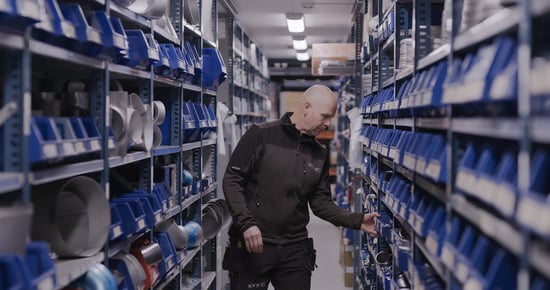
_SVS_-7

Wide selection: SVS goes the extra mile to find what the customer needs.

Recognizing these challenges, SVS evaluated several systems, ultimately selecting RamBase QMS for its comprehensive approach to quality management.  Velde highlighted the decisive factor:

"RamBase’s methodology for handling documents and competencies, particularly the ‘read and understood’ functionality, stood out. Knowing with confidence that the right version of a document has been communicated to employees is invaluable."

Another key factor in their decision was RamBase QMS’s use of visual tools.

"The ability to integrate images and videos, instead of relying solely on long texts, makes a huge difference for us. It’s not just practical; it’s also aesthetically pleasing and aligns with how we want to communicate internally,” said Velde."

Supporting ISO standards

As SVS continues to expand, meeting rigorous ISO standards has become a strategic priority. The company is working towards compliance with ISO 9001 for quality management, ISO 14001 for environmental management, and ISO 45001 for occupational health and safety. General Manager Håkon Sandvold elaborated:

"Our large customers in various industries expect us to meet these standards, and having the right tools in place is essential. RamBase QMS will play a important role in helping us streamline our documentation, communicate changes and embed best practices across the organization."

This structured approach will enable SVS to not only meet customer expectations but also enhance internal processes and ensure that their quality management system scales with their growth.

A perfect fit for SVS

Customer Success Manager Pia Heia emphasized how well SVS and RamBase QMS align.

"Sandvold & Velde Supply’s dedication to quality and their forward-thinking approach make them an ideal match for our system. They’re not just implementing software; they’re embracing a way to elevate their processes and meet both current and future demands,” Heia said."

MarkVilliams

Product Manager | Capsule

Comments (0)

Leave your comment

No comments here yet, start first!

Leave your comment
Add the comment

You may also read:

From coat to full control – five levels for better financial management

“Find the coat!”, he said and threw a new set of travel expenses on the desk. Some time ago, an acquaintance of mine had an expense claim for a raincoat rejected. He had bought it in connection with a conference when it suddenly started to rain. The company should cover that much, he thought. The company didn’t think so. They asked him to review the travel invoice again. He went back, summed up and assessed, and submitted a new travel expense report with the same final amount, but without a visible coat. If you don’t have a reasonable level of granularity in your bookkeeping, it’s possible to hide the coat. Why detailed accounting is an economist’s dream Every economist’s dream is a specific set of accounts where the information available can enable useful and good analysis. A data basis where you don’t have to make assumptions or guess at allocations. Just as an engineer must consider strength measurements and material properties when constructing a building, finance must build its reporting and accounting data in a detailed and forward-looking way. Block Quote Level 1: Chart of accounts – the foundation of accounting In a traditional set of accounts, you’ll find main accounts showing income, expenses, assets, and liabilities. But for most businesses, these figures only scratch the surface. On their own, they add limited value. Compared to historical figures, they may be slightly more informative, but only slightly. The level below is various general ledger accounts that are part of an accounting group. Here it may be common to create an account for rent, one for cleaning, one for exterior maintenance, all of which will make up the main group “office costs”. You can do the same on the revenue side. Some people have an account for products, one for maintenance and one for service assignments. Then you have broken down total revenue a little more and can look at the change between the different main categories. But to take the analysis a step further, we need to look at where in the organization the revenues and costs actually arise. Level 2: Departments – cost allocation where it happens Most companies are divided into departments, which means that both revenue and costs can be recorded where they occur. It’s often straightforward to set up a departmental structure, but accurately allocating costs to the right departments can be challenging. At the same time, you must avoid the internal invoicing trap, where the focus shifts from optimizing company-wide value to maximizing departmental performance. Read more: ERP for the CFO Level 3: Customer and supplier – the key to financial analysis This one goes without saying: using customer and supplier data in financial analysis is invaluable. How much do your suppliers invoice annually? Who are your most important customers? What is their share of turnover? How has it changed since last year? Customers and suppliers can also be grouped into categories. RamBase offers many options for this, predefined or user-defined fields such as: Industry sector Geography Supplier size Classification (a, b, c supplier) RamBase also has dedicated fields for end customers. This means you can track not only who you invoice but also who actually uses the product. Companies subject to export controls and international trade regulations can benefit especially from this. Read more: Why your CFO’s input is crucial when choosing an ERP system Level 4: Additional dimensions – freedom to customize There are several dimensions that can be linked to individual transactions in the system and used for reporting and analysis. RamBase supports up to 10 dimensions, and here only your imagination sets the limits. These dimensions can be linked to general ledger accounts, sometimes as mandatory fields, to ensure proper classification before approval. Relevant dimensions might include: Geography Purpose Project number Activity dimension However, it’s easy to get overambitious and add too many mandatory dimensions. Be sure you’ll actually use the information. A dimension only adds value if the data quality behind it is solid. Level 5: Products and product groups – detailed product insights By creating separate articles for your products, you can break down the revenue base even further. How many units of product X have you sold? What is the average price? What is the net growth and in which customer group is the change most pronounced? RamBase allows detailed product specification. You can define fixed sales prices, predefine accounting rules, link to suppliers, and more. Products can also be grouped into product groups, enabling reporting independent of general ledger accounts. Read more: Get to know the finance module in RamBase Cloud ERP  Where’s the coat? If my acquaintance’s employer had taken a thoughtful and detailed approach to accounting data, he would have left the payroll department empty-handed. It wouldn’t have been possible to hide a coat among the totals and call it something else. We have to hold two thoughts in our heads at the same time. We can impose all kinds of requirements for details and specifications, but sometimes it’s more efficient to let a few details slip – like the coat – rather than spend significant resources maintaining the quality and granularity of our data.
From-coat-to-full-control-five-levels-for-better-financial-management

RamBase
Central Europe
300 people
View profile
Industry
Automotive, Dystrybucja, Produkcyjna, Usługi
Description
Intelligent ERP system for manufacturing and wholesale businesses....
expand