
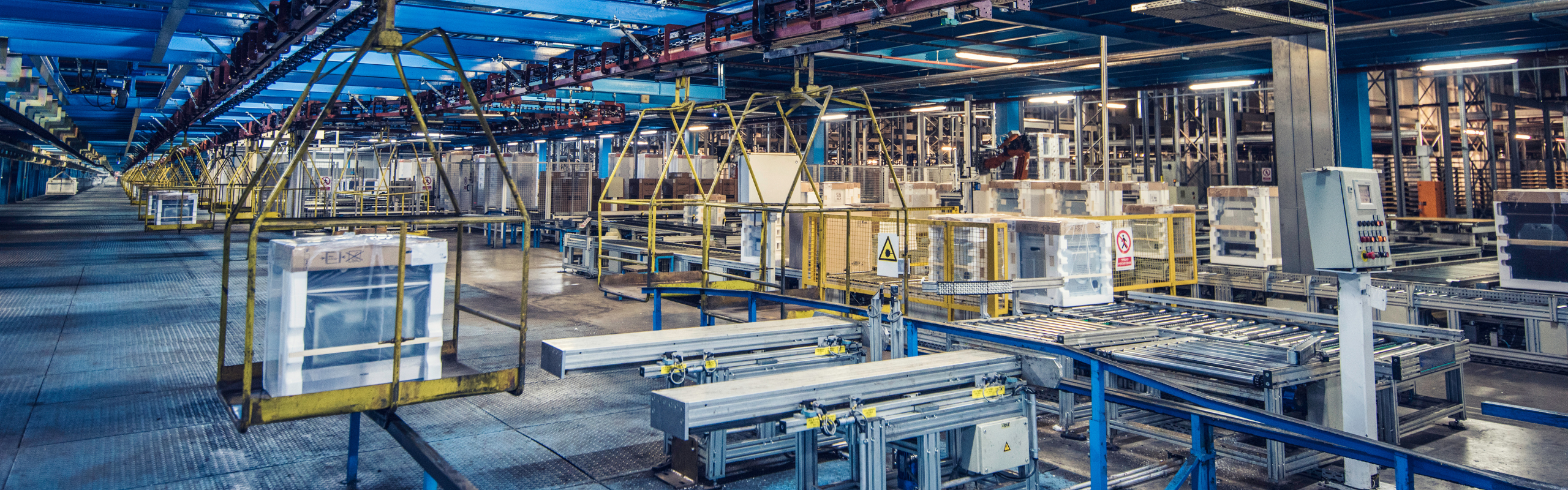
Products moving on production line

Managing Defects on the Fly. How do MES Systems Optimize the Handling of Defective Products?

The occurrence of defective items in production is an everyday reality for every factory. The key to maintaining profitability is not only preventing errors, but also the ability to properly manage them when they do occur. This process is supported by modern MES (Manufacturing Execution System) class systems, which enable advanced defect handling. Thanks to this, operators can classify and manage non-compliant products without interrupting ongoing production.

Precise Classification of Defective Products

Traditional systems often force employees to simply mark damaged parts as "defects". This, however, blurs the picture of what is actually happening on the production line. This approach is prevented by Production Execution in the Operator platform.

The Production Execution module is an MES terminal that becomes a communication channel between the production hall and the system. In addition to comprehensive production reporting capabilities, the terminal enables advanced waste reporting (so-called outsort management). It supports the disposal process while simultaneously allowing for the introduction of all corrections, performing repairs, and handling so-called re-work products.

The result? Operators gain the ability to accurately determine the causes of errors. Because of this, subsequent quality analysis becomes a solid foundation for minimizing material losses.

5 Paths for Dealing with a Defective Product

Managing defects on the fly requires a flexible approach. The Operator system offers five main classification paths for units that require additional intervention:

  • Direct Repair – a feature that enables direct repair of a defective part without interrupting ongoing production. The operator can repair the product on the spot and immediately return it for further processing.
  • Repair – involves repair actions at the production workstation, but they are performed at a later time. This can occur, for example, after the completion of the current production run.
  • Rework – otherwise known as reworking defective goods. This allows you to modify products and give them a new material code or create entirely new products.
  • Scrap – the final classification of a product as waste that is unsuitable for further processing or repair.
  • By-products – these are elements or semi-finished products created during the manufacturing of the main product. Parts classified this way can be effectively utilized in future production processes.

Defects on the Fly – How to React Quickly?

When we free operators from the necessity of working at stationary terminals, quality management becomes much faster. The Operator Mobile App enables the registration and classification of production waste directly at the workstation. In turn, the Quality Control module guarantees immediate quality monitoring at all stages of production.

Mobile solutions also facilitate access to data on quarantined products. Thanks to this, it is possible to report test results and streamline their release process.

Why Is This So Important for the OEE Indicator?

Entering the causes of rejections and errors in real-time provides invaluable information for the entire factory. It allows for a comprehensive analysis of production quality on an hourly or shift basis. Furthermore, the precise identification of defective batches will allow for targeted product recalls and cost reduction.

Treating quality defects as an inherent element of the process and implementing tools to manage them on the fly is a huge step towards Industry 4.0. Instead of stopping the entire line, employees can act in a planned manner. In the future, the data collected in the MES system will allow for the elimination of bottlenecks in the area of quality.

Do you want to check how such a solution will work in your factory? If you are in the process of looking for a system to optimize production, we invite you to contact us and schedule a demo.

Comments (0)

Leave your comment

No comments here yet, start first!

Leave your comment
Add the comment

You may also read:

How to Automate Machine Data Collection?

Machine data collection is the foundation of reliable OEE (Overall Equipment Effectiveness) analysis. Without it, it is hard to speak of proper control over factory efficiency. How can this be properly automated so that analytics are no longer based on guessing and manual reporting? Automated data acquisition drastically changes daily work on the shop floor, significantly streamlining it. The system is the first to notice a failure. Instead of forcing an employee to manually record the start and end times of a downtime, the software automatically registers every stop, even the shortest ones. The very nature of the operator’s work also changes. With digitalization, their task is reduced solely to categorizing the event that occurred. It is worth noting that in modern implementations, the downtime reason code itself can be delivered to the system automatically, directly from the machine (e.g., via communication protocols such as OPC). In such cases, the employee simply verifies the correctness of the automatically assigned code on a dedicated touchscreen. They can also leave their own comment or note, which supplements the raw machine data with unique context. What Is the Significance of Machine Data Collection For Analytics? Depending on the machine type, systems can collect a single key signal or a whole range of them. The Operator Datalogger module allows for the collection of various production and environmental metrics. Even seemingly simple information can provide key business insights: Machine operating status – for example, this can be determined based on measuring the energy consumption of a machine tool spindle. Number of cycles (takt times) – counted, for instance, based on every pedal press by a press brake operator. Automatic error and downtime codes – if these are generated by the machine, the system helps identify the cause of the production stop. A specific error code immediately appears on the digital screen. Process and environmental parameters – such as current temperature, pressure, voltage, humidity, or shaft speed. These are recorded from sensors in real-time. Thanks to built-in algorithms, these basic signals are analyzed in real-time. This allows for the precise identification of machine availability issues, such as breakdowns, unplanned downtimes, or speed drops. Statistical Process Control – What Is It All About? Monitoring efficiency using the OEE indicator is only half the battle. Gathering process and environmental data directly from the workstation is equally important. This is the purpose of Statistical Process Control (SPC), a method of monitoring a process using statistical data aimed at verifying whether the process is behaving stably and predictably, or if unusual disturbances are occurring. Implementing the SPC module in an MES (Manufacturing Execution System) allows for continuous tracking of variability—that is, differences resulting from material properties, micro-fluctuations in temperature, standard machine and operator work, etc. Crucially, the software measures process stability and allows for the early identification of a problem before parameters exceed nominal critical values and control limits. The system analyzes deviations based on advanced statistical rules, e.g., the three-sigma rule. This solution makes it possible to catch deviations and problems before they negatively impact the final product, significantly reducing waste. Additionally, the system sends proactive alerts. When the value of a monitored machine parameter exceeds a set level, the system automatically generates notifications via email, SMS, or as an alarm on dashboards. However, it is worth remembering that simply implementing software for automated machine data analysis will not fully replace the SPC methodology. In reality, Statistical Process Control is a much broader engineering approach, encompassing, among other things, conducting a reliable measurement system analysis. An MES system like the Operator Platform provides an incredibly powerful tool that helps quickly catch process instability. However, the foundation of success remains the implementation of the SPC culture and comprehensive methodology itself by the engineers at the manufacturing plant. How to Communicate with a Machine Effectively? The method of data acquisition strictly depends on analytical expectations. The Operator Platform supports a wide spectrum of communication protocols. The most effective and recommended solution is direct communication via OPC / OPC UA or a modern IoT protocol, such as MQTT. These ensure seamless, real-time data transmission. Alternative solutions also exist. The system can be integrated with machines through direct database connections, REST API services, or even file interfaces (e.g., CSV, XML). However, one must keep in mind the technological limitations of each method. If the business goal is to capture micro-stoppages lasting just a few seconds, relying on importing CSV files generated by the machine every minute will be technically insufficient. In such cases, real-time communication is essential. An Older Machine Park Is Not a Dead End Many manufacturers fear that the lack of modern interfaces in older equipment makes digitalization impossible. Nothing could be further from the truth. When direct access to data from a PLC controller is difficult, there are several proven integration paths: Software modification – interfering with the controllers’ source code (usually possible for machines to which the plant has full access and rights). Cooperation with the supplier – establishing direct contact with the machine manufacturer to make the appropriate registers accessible. Retrofitting with sensors (“Sensorization”) – the most universal solution. It involves equipping older equipment with independent, modern sensors connected to an external data analyzer or I/O module. These elements translate the machine’s physical operation into digital signals understandable by the MES system. Full Partnership Support The approach to the digital transformation of a production hall must be flexible. The Operator Platform enables the implementation of all the hardware integration variants mentioned above. Regardless of the machine park’s age and the communication protocols used, our software successfully transforms raw machine signals into reliable indicators, providing management with the knowledge necessary to make accurate business decisions.
Two people in business attire overlook a vast automated factory floor filled with rows of manufacturing machines.
Operator
zweryfikowano

0/5

OPERATOR SYSTEMS A/S

Accelerated Improvement


Central Europe
+1
50 people
View profile
Industry
Automotive, Meblarska, Produkcyjna, Spożywcza FMCG, Produkcja maszyn, Produkcja zaawansowanych technologii i elektroniki, Cyfrowa transformacja przedsiębiorstw
expand